Monday, October 21, 2024

5E Selkie Species

I ran a 5E one-shot for some new players recently in the Legends of Alba setting. My partner was playing in the game and has been keen to play as a selkie character for a while, so it seemed like the perfect opportunity to put together some rules for a selkie species. I've tinkered with them a little since our game and wanted to share it here for anyone else who fancies playing as a Selkie in D&D 5E!

Selkie by James Browne

Selkie

Selkies are Fey shapeshifters, each possessing a seal skin that allows them to transform between seal and human form. They are the children of the Goddess Mitha, Mother of The Sea, whose song calms the most violent tempest. It is this song, the song of the summer tides, that imbues the spirits of Selkies with the light and magic of The Feywild. With a song in their soul, it is no surprise that so many Selkies exhibit an open joy in movement, moving through the steps of their long lives (commonly over 400 years) as though through the steps of a dance.


In their seal skin, their seal form grants them speed and grace in the water, as well as the ability to withstand and navigate the cold darkness of the deep sea, where submarine caverns hide the Fey Crossings to The Land Beneath The Waves. So a selkie’s seal skin is their greatest treasure: It is their connection not only to nature, to the wild seas and their Goddess, but to their ancestral Feywild home.


Though their hearts belong to the Sea, Selkies are often drawn towards the land. When a Selkie removes their seal skin, they are indistinguishable from humans. They can therefore be found in coastal communities throughout the multiverse, living among the short-lived folk till the ebb of the tide calls them home at last.


Selkie Traits


Creature Type: Fey Size: Medium (about 4-6 feet tall) Speed: 30 feet As a Selkie, you have these special traits. Darkvision. You have Darkvision with a range of 60 feet. Seal Form. You possess a seal skin. Once per round, you can don or remove your seal skin for free to shift between Seal and Human Form. The following traits apply to you in Seal Form: Speed: 10 feet, swim 40 feet Armor Class: 11 + Dexterity modifier (natural armor). Hold Breath: You can hold your breath for 10 minutes. Damage Resistance: Cold. Bite: Melee Weapon Attack (Strength), 5 feet, D6 piercing damage. In addition:
  • You lose the benefit of worn or carried equipment, which merges with you into your seal form.
  • You can’t cast spells, but shifting does not interfere with spells you’ve already cast.

Wild Nature
. Your deep connection to the Feywild grants you proficiency in one of the following skills of your choice: Athletics, Acrobatics, Insight, Nature, Performance, Survival.

Friday, October 11, 2024

Elden Ring Has a Good Map

I’m not normally a big fan of exploration in computer games. So why am I still having a blast exploring the open world of Elden Ring? A big part of it is down to the map and specifically how the map is populated.

Progression in Elden Ring is gated by challenging Legacy Dungeons. Each of these are unique and packed with visual storytelling, setting the tone for a memorable Boss battle at the end. This is the content that the game is pushing you towards, and for good reason: These sections should seem very familiar to anyone who’s played the Dark Souls games. FromSoftware has a proven track record of getting this stuff right.

But unlike Dark Souls, Elden Ring is open world. Often there is nothing whatsoever preventing you from galloping between Legacy Dungeons. You don’t need to explore the open world, so why bother?

Because the Legacy Dungeons are very difficult and, unless you’re a very skilled player, you’ll need all the help you can get. This is where the exploration element reveals itself as core to the Elden Ring experience. By exploring, your character will become more powerful, you’ll get better gear and that will help you in the Legacy Dungeons. As you explore, you’ll also start to recognise ‘types’ of location, each of which serves a purpose. All of this together elevates the exploration from being a grind or worse, a pointless activity, to being something that sparks imagination and curiosity.
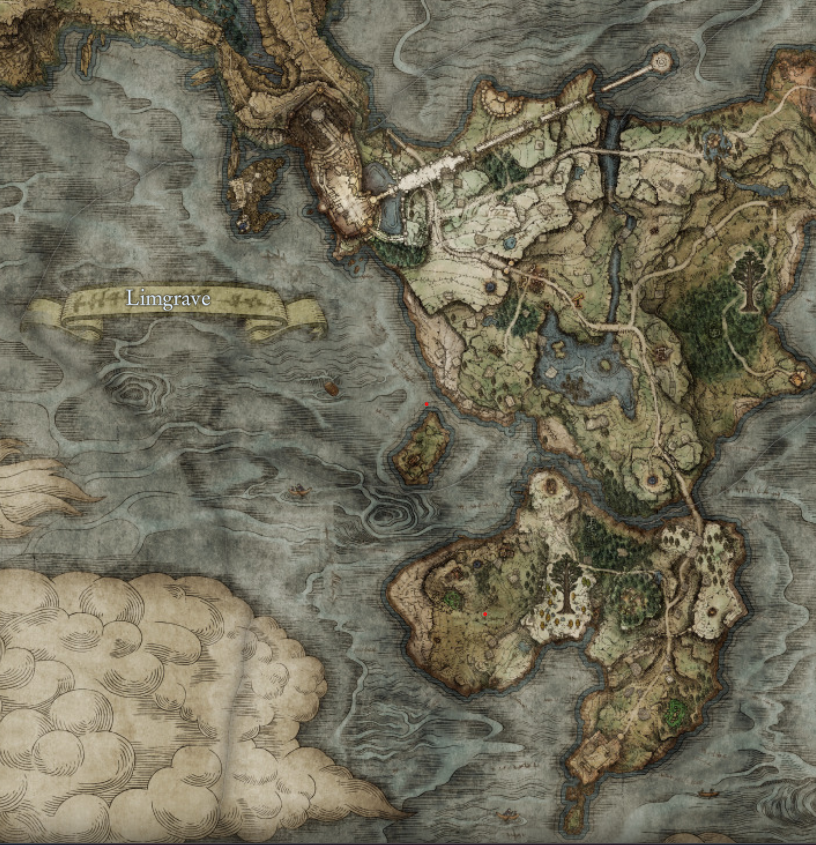
Limgrave

Let’s look at what sorts of locations you can find in Elden Ring:

Legacy Dungeons are usually huge castles in a prominent location. They’re large and challenging areas culminating in a significant Boss fight. These are your road-block Boss areas discussed above. Certain very powerful Bosses yield a Great Rune on defeat, a fragment of the titular Elden Ring whose power can be unlocked at Divine Towers.

Divine Towers are drawn as star-shaped towers on the map. They have strong connections to The Two Fingers - a major religious presence in the game. Each tower is linked to a Boss whose Great Rune can be unlocked at these locations to gain access to their unique weapons, armour or spells.

Minor Erdtrees show as large stylised trees on the map. They’re lesser versions of the Great Erdtree, that one gold tree that’s so big that you can usually see it if you can see the sky. Each Minor Erdtree is guarded by a stalwart Erdtree Avatar, a mini-boss made of roots. Defeating this guardian grants you a Crystal Tear: Items which you can combine in your Flask of Wondrous Physik to give your character a powerful buff.

Catacombs are not marked on the map but are normally found near Minor Erdtrees, signposted by a statue bearing the message “Guide and gatekeeper for those returning to the roots”. Following the direction indicated by these statues leads to a Catacomb - so maybe the statues are placed there to help lost souls find their way to the afterlife. The Catacombs themselves are tricksy mini-dungeons: Traps and ambushes abound. Usually you have to find a lever hidden within the dungeon to open the door to the boss. These areas are rich in Grave Gloveworts, an upgrade material for your Spirit Ashes (helpful allies you can summon during Boss fights)

Caves/Tunnels have their entrances marked as glowing pits on the map. Usually they present as mines, many of the enemies here are just working away and not hostile unless you go right up to them and start fighting them. These also usually have a mini-boss at the end. These are the best places to find Smithing Stones, the upgrade materials for your Weapons.

Wandering Mausoleums are bizarre huge tombs that walk around on four stone pillar-like legs. They are not marked on the map but you know when they are near when you hear their dolorous bell ringing. You can also hear them stomping around if you’re close enough. You can knock these over to duplicate Remembrances, providing some good utility in giving you a second chance with a powerful single-use item. They also serve the important role of reminding you that the world of Elden Ring is weird AF.

Evergaols are marked on the map by concentric circles. They are stone-floored circles which can be activated to transport your Character to a sort of pocket dimension where you fight a Boss who is imprisoned there. You’ll be rewarded with runes to help you level up, and a potentially useful item.

Ruins hint at a forgotten past and are usually populated by enemies. They often conceal a basement with a helpful item.

Churches enforce the presence of Marika, the missing ruler of The Lands Between. They are a good place to look for NPCs and grant the rare Sacred Tears, which help your character regain health.

Rises are wizard’s towers, though more often than not the owner is absent. They will usually present a puzzle such as “find 3 sacred beasts” (which in Elden Ring are, of course, turtles) to grant access. Your reward is a memory stone, which allows spellcasters to memorise more spells.

Forts are usually intact, well guarded strongholds. A direct approach will normally be met with a hail of fire or arrows from unseen assailants. So caution and knowledge of the layout is advised. You’ll normally face one or more difficult 'commander' type enemies, such as Knights, with a weapon or other useful item as your reward.

Villages tend to be places where something awful has happened. You are invariably much too late to save anyone but you can learn something about what happened (and when a place is named “Frenzied Flame Village” that can be a big motivator), meet NPCs and find items here.

Shacks are humble dwellings dotted around the world. Sometimes they are shelters for NPCs, they are also likely to contain spells or upgrade materials. These are fairly minor, sometimes almost incidental, locations but I think go a long way towards making the world like real people lived here.

That’s not even an exhaustive list of all the types, but hopefully more than enough to convey the strength of Elden Ring’s open world and why I love to explore it. Everywhere has a purpose, everywhere has a story. Exploration in Elden Ring is never a waste of time.

Saturday, September 21, 2024

Characters in Legends of Alba


Waaaay back in July I wrote about some rules ideas for the game, and finished up by saying that the next step was to have a look at building some characters. So in the 3+ months since that post I've been working on the Character creation process for the game and am delighted to be writing today that I have some thing to share:

Here is a sort of preview, WIP, very non-final draft for Character Creation!

A few caveats:

  • In the Homelands section, the Kingdoms of Alba are all named, but 'The Storm Isles' is the only available option just now.
  • In the Heritage section, I want to include more options here as I quite like these. For those select few who know what this means, I've not forgotten The Lizard Legion. There's no way this game is getting finished without the option for you to play as a lizard person if you want.

Even just getting to this point, it's been an interesting, challenging and fun process. My initial idea for making characters was to have you roll for your Clan and that would be it (so the clans would be similar to Backgrounds in Troika or Failed Careers in Electric Bastionland). But I wanted Alba itself to have a stronger presence, even when making your character. So your character's homeland has become the most significant decision or roll you'll make in the Character creation process, and that feels right to me.

art by André Houot, via The Lost Treasure Chest

As for the Clans themselves I'm quite happy with where they're at. I enjoyed writing the mottos and bringing a little bit of Westeros energy to them. And I think they achieve another aim that I had for this process, which was for it to serve a dual role as a referee resource as well. For instance, if you're the person running the game, and you wanted to introduce an NPC who happened to be from the Seawolf clan, you could have a quick look and see that the Seawolf equipment list includes charcoal and chalk hair dye, so a noticeable detail about this NPC might be their jet black hair with white streaks through it.

Perhaps my favourite discovery from this has been the Truths mechanic. Truths are exactly what they sound like: True statements about your Character. If one or more of your Character's Truths would be beneficial when making a Check, you can re-roll the Check. Depending on the Truth and the situation, the Truth might mean you don't even need to make a Check.

Having decided on that, I revisited how Fire might work. Fire is not that easy to get. So when it is used it should be big, it should be impactful, it should be your Character realising their full potential. So: When your Character has to make a Check, you can burn Fire to automatically succeed on the Check. Guidance for the referee will be to offer the player the chance to describe the best possible outcome, if they wish.

There's more I'd love to get into but I'm already way over the time I have for writing this post, so I'll round off with a sample Character I rolled up last night using this Character Creator. The notes at the bottom are my initial thoughts on what this character would be like, using the results from the Character Creator as prompts. I found these ideas came pretty naturally but I've had my head in this stuff for a while now, so it might be useful to include some guidance for new players on fleshing out their character in this way.

Meantime I've come up with a character that I'd be excited to play, which is a good starting point at least!

*******

Name: Ada Wavesplitter
Homeland: The Storm Isles (Survived the worst winter by staying ahead of the storm)
HeritageÙruisg
Service: Messenger

Talents: STR +2 | SKL +5 | SNS -1 | SLF +0

Clan Wavesplitter: To the surface, the best
Oath of Renown:
* Gains Fire when her actions improve the reputation of The Wavesplitters.
* Broken if she wilfully denies or conceals her belonging to The Wavesplitters.

Truths:
* A seasoned sailor
* Makes weather predictions, usually accurate
* Gets restless if she stays in one place too long
* Sees things others miss
* Knows how to conserve stamina

Equipment
* Hook-heeled hatchet
* Round studded shield
* Horsehoe chestbrand
* Companion moss
* Hooded crow (can repeat one short phrase)

Notes:

As a messenger and a sailor, Ada has spent a lot of time traveling aboard the ships of The Wavesplitter fleet, delivering important messages between clans. 'Skill' is her best Talent, and she conserves her energies well, so she prides herself on her speed and reliability as a messenger. She takes her work seriously, keenly aware of how it reflects on her clan. And of course, she can be heard proudly talking up The Wavesplitters whenever she can, as sworn in her oath.

I don’t think there would be one particular ship or crew she always sails with, her work is so ad-hoc that she has to be flexible, finding passage with whoever suits the job. Her secondary Talent is 'Strength', so she’d probably prove quite useful at sea. And while her ‘Self’ Talent has no bonus (so she's not particularly charismatic) she would have to have learned how to get along with others quickly. I’d role-play her as a positive, can-do sort of person, with a grin that comes easily to her face as long as she's traveling.

The Heritages - intentionally - give only a very general idea of appearance, aiming for just enough to give a distinct silhouette but still allow players maximum freedom of expression here. For Ada's appearance, I can see her having square pupils and slightly curved horns that arc backwards from her short, tufty, golden-brown hair. She has light speckled fur on her back and forearms, gradating to darker coarser fur that entirely covers her legs.

For her “worst Winter” event, I imagine a sudden storm left her stranded with a small crew on a remote isle as the full terror and darkness of that Winter closed in. It was too dangerous to stay, so there was no choice but sail on in the terrible weather from island to island till at last the roiling seas had calmed and they could return home. Her 'Senses' are her worst Talent, so she’s normally quite oblivious to the world around her, but this experience left her with a keen intuition for changes in weather patterns, and she often casts an anxious eye to the sky if dark clouds roll in.

She has a lot of time to do herself between sea voyages, during which she talks to the moss (fixed onto her leather shoulder strap) like an old friend. I do like the weirdness of the companion moss a lot! It's also a nice contrast as a companion for Ada (moss typically grows on things that stay still for a long time, but she HATES to stay in any one place for too long...) 

*******

That's all for now, until next time!

Thursday, September 12, 2024

Tabletop Scotland 2024

I went to Tabletop Scotland at the weekend and it was awesome! This was my first time attending and I was blown away by how much there was to see, and the positive atmosphere and enthusiasm that seemed to energise the whole event. I felt like I could have happily drifted around the makers’ stalls talking to the artists, writers, designers and crafters there about their cool stuff indefinitely.

I was also pleasantly surprised by the abundance of indie RPGs on show. It was hard not to have ideas sparking off in my head about games I JUST CAN’T WAIT to run, harder still not to just spend ALL OF THE MONEY on weird little books and new games. I did spend more than I planned but have zero regrets and wanted to highlight a few standout faves:

"Odd Jobs" by Macguffin & Company

Macguffin & Co. was the first stall I stopped at and although I didn’t realise it at the time I’m 90% sure the person I spoke to was Jonathan Sims, whose voice I’ve listened to for hours on the excellent audio drama The Magnus Archives. He made a great pitch for their book Odd Jobs, which is a collection of RPG Micro Settings. These are intended for running short campaigns and are system agnostic, which is not something I’ve seen much of. I was really impressed by the diversity and imagination in the settings themselves, and looking forward to running one of these as a break from my regular games.

"For Small Creatures Such as We" by Blackwell Games

I was keen to check out Blackwell Games after seeing Anna Blackwell speaking about Fantasy & Folklore in games at one of the panel discussions. When I got to their stall there was a copy of For Small Creatures Such as We, open at this page:

One does not simply walk away from space otter.

Sold! This is a solo/co-op sci-fi game where you play the Captain of a spaceship and travel around the galaxy doing jobs to get paid and have adventures. There’s a big emphasis on customising your ship and hiring your alien crew as well, so my partner and I are really excited to play this one together and see where it leads us.

"Maskwitches of Forgotten Doggerland" by Handiwork Games

My favourite discovery from the convention. I’d not even heard of Handiwork Games and it turns out they are based in Falkirk, which is actually where we were staying over the Tabletop weekend! I was hooked by the mixed media cover-art (which reminded me a bit of Dave Mckean’s Dust Covers), and reeled in by the title. This is a game in which you play witches in the mesolithic era, travelling through true wilderness between primitive settlements, helping the communities there and banishing dark spirits. It’s a rules-lite, story-focussed game and the vibe is very much in the same wheelhouse as my version of Hags in Legends of Alba. It’s exactly what I want to see in a game about witches: Exploring a vision of the witch as a healer, a sage, a wise woman with a strong voice in the community. I couldn’t wait to get this one home to start reading, and cracked it open on the tram back into Edinburgh from the venue. Aside from the game itself there are also really interesting stories about its artwork, and the inspiration for its setting. This book really is something special.

That’s by no means an exhaustive list of the games I fell in love with at Tabletop Scotland, and not even close to a list about everything I enjoyed at the convention, but it is all I have time to say with this post. I’m already excited for next year’s event and who knows? Maybe I’ll have something to run or show off for Legends of Alba by then! 

Till next time!

Thursday, August 8, 2024

Inspiration: The Northman

I watched The Northman recently. It was fantastic, and I've been thinking about it a lot. Before I say anything more about it: Spoilers ahead. With that out the way, here’s 10 things I remember from the film:

  • An active volcano
  • Longships on a rough sea, returning with treasure
  • Mystic seers in firelit barrows
  • Warriors empowered by beast spirit rituals
  • Björk as a Hag!
  • Death-shinty?!
  • A sword that can only be drawn at night or at The Gates of Hel
  • A battle for that same sword with a SKELETON THAT COMES TO LIFE
  • Bloody vengeance!
  • A valkyrie riding into the gates of Valhalla

Powerful stuff! And nothing in that list would feel out of place in Legends of Alba. Watching the opening, which shows longships approaching a coastal hill fort, felt just like seeing through my mind’s eye when I’ve been thinking about the game. It was an exciting moment, because so much of it is still only in my head, I’m always glad to discover things that already exist that I can point to and say, “it looks like this”:


Hrafnsey, from The Northman

So it was inspiring for game design reasons, but I also loved how it went about telling its story. Norse mythology feels like pretty well-trodden ground (maybe more so in games than films) and often you’ll get straight-up retellings of the Norse myths, maybe even characters from those myths will feature to add authenticity. The Northman isn’t an original story either (I understand it’s based on the legend that inspired Hamlet). Where I think the film shines narratively, is in taking the values and beliefs behind the tales it draws from, and telling its story with those ideas at its foundation.


It’s a revenge tale. There’s catharsis and you’re encouraged to feel it alongside Prince Amleth (the protagonist) as he reaps bloody vengeance. But it also doesn’t shy away from the hollow non-life of a character like that. He cannot truly live until his tragedy is avenged. But what life remains for him after that?


Along the way, there is the suggestion of an answer to that question, a path opens up that could lead Amleth to a resolution, if not to happiness. He meets his equal in Olga, whose sorcery(!) proves a match to his might. She gets an awesome line which I am probably going to misquote but it’s something like “You can wound a man’s body. I can break his mind”. She’s a great character and together they make an excellent team. They go on to forge a relationship based on companionship, respect and trust. It was an unexpected but welcome thing to see in a film like this.


But this is also a story about VIKINGS seeking a warrior’s DEATH in BATTLE! And it makes a point of glorifying this belief, as those who held it might have. Amleth’s visions - of being carried off on horseback by a magnificently fierce-looking Valkyrie, to where he is awaited in Valhalla - look incredible. But the film also (I think) shows the stubborn and wounded-masculine side of this fantasy. Towards the end he and Olga, now pregnant with their unborn twins, are bound for escape. A future together in Orkney. A fresh start. But Amleth, still not done with the old vengeance, dives off the boat and swims ashore to face the final showdown. He chooses to secure a good death at the cost of a good life. It’s tragic, it’s vainglorious, it’s idiotic.


I’m spending a lot of time just now poring over old myths and folklore, along with anything I can find on Scotland’s pre-Christian history. It’s tempting to look back on the beliefs of that time as being more virtuous than those of today. This was Before Capitalism, after all. But thinking about the ideas in The Northman, it seems just as likely that there were equally stupid and toxic beliefs back in ancient times too. Good to keep perspective I think.


So that’s The Northman. What an absolutely smashing film from two years ago.


That’s all for just now, till next time!


Tuesday, July 9, 2024

Fire & Fatigue

Writing Legends of Alba as a 24XX game (see last post) helped solidify some ideas about what I want from a ruleset for this game. I want it to be brief, the core rules should take up no more than 2 sides of A4. I want it to be intuitive, appealing to common sense through plain language. But I also don't want to throw the baby out with the bathwater: There needs to be enough design space to play with to give interesting benefits for Character backgrounds, equipment, magic items, and rewards during play.

So expanding on the core resolution mechanic I talked about here, I've added a few concepts which I consider essential. You can read the WIP ruleset here.

Fire
I like having ways to reward Players for great role play, creative thinking, clever tactics etc with the chance to turn luck in their favour when it counts. Things like: Rolling with Advantage in 5e; making an Enhanced Attack in Into The Odd; Creating an Advantage in Fate. So I'm thinking about "Fire" for my take on this. I mentioned Fire briefly at the end of the last post, and that it would essentially be the Character's inner fire. On the edge of cheesiness perhaps but even so I really like it, so I'm sticking with it for now. So with Fire as a reward, the behaviour I want to reward most is Characters acting "in-character". So this seemed like a good way to encourage players to engage with their Character's Clan* as well, so for now fulfilling a Clan Virtue is the main way to get Fire, which you can burn for a re-roll.

Fire Digital Art CC BY-NC-ND 3.0 by MayGoldworthy

Fatigue
I'm curious to see whether or not this actually works in play: I'm not planning to have Hit Points in Legends of Alba (!). Characters will however be travelling around in harsh conditions and fighting dangerous enemies so I think it's important to reflect the toll of this mechanically. I also want to give players an incentive to seek out hospitality because in doing so they'll get to speak to folk - the best source of info on the locale. My concern with Fatigue as it's written is that it might just feel lousy for players to have this number sitting on their Character sheet as a constant debuff till they can clear it. Might players simply prefer hit points that get whittled down harmlessly till their Character drops dead?  We'll have to see!

Wounds
Why have lasting injuries in this game? The story of Nuada The Silverarm mostly. I'm not sure they need to be strictly enumerated like this (Minor, Major, Mortal) but this felt like a natural way to go, and I quite like this loose representation of a Wound as an answer to the questions: "What treatment is required?" and "How long will it take to get better?". It took a bit of spinning to get here however because the main way to get Wounds is going to be through Combat. So what does Combat look like in this game? While I don't want unique rules for Combat - ultimately it's just a Check, right? But it's such a common situation, and the stakes tend to be higher, I think it would run more smoothly if there was a procedure to follow, so I'm thinking about that.

This feels like a good point to take a step back. Even working out a Combat procedure is a big job. The main things I want Combat to do in the game is first provide opportunities for dramatic, memorable moments and, second, complicate the lives of the Characters. That's a decent start. Having had a think it feels like the main question I need to answer next is what sorts of things might Characters be able to do, so my plan next is to keep these principles in mind and try to build some Characters!

* Clans are a big deal in Legends of Alba and probably need their own post later on! For now the important info is that each Clan has a unique Virtue they hold sacred (e.g. Truth, Status, Friendship)

Tuesday, June 25, 2024

Alba: 24XX

Still on the road towards an original ruleset for Legends of Alba, I took a side path into the world of 24XX. For the unfamiliar, 24XX is the SRD created by Jason Tocci to accompany his 2400 series, a collection of modular, rules-light RPGs. They all follow the same 4-page format, designed to be printed double-sided on a single sheet of A4, with a cover page for art, the middle pages for the rules and character creation, then the back page devoted wholly to random tables for creating adventures. I absolutely LOVE these games! Each one is so packed with ideas and the setting comes through so clearly through the wild cover art, character options and adventure tables. It's impressive and inspiring stuff.

I'd already been thinking that it might be worthwhile trying to write up Legends of Alba using a few different SRDs, sort of like trying on a bunch of different hats to see which hat suits you best. Or maybe even just to get an idea of what you actually want in a hat. It can be a hard question to answer if, like me, you're not really a hat person. So over the last couple of weeks I've done a treatment of Legends of Alba using the 24XX SRD, and you can check it out here!

Fingal's Cave, Island of Staffa, Scotland by Thomas Moran (public domain)

I've not play-tested the game (maybe someday?!) but it's at a point where I'm happy to leave it for a bit. It was a lot of fun to write, and a really useful exercise. I wanted to record and share some of the things I learned from it, so here we go:

SCOPE: When you've only got 4 pages, the scope wants to be narrow and specific. Probably more so than what I went with. This will be my D&D background showing, but Legends of Alba is quite a big setting in terms of scope. There's clans, kingdoms, there's the hags, there's The Legends, The Otherworld, there's deities, there's history, there's the land of Alba itself... any one of these could be a 24XX game on its own probably. I'd like to try again and do a 24XX game based around the clans of Alba, where its all about reputation and community; then maybe another separate one on weird and wonderful Otherworld adventures. I think either of those ideas would fit the format well.

TIME: Part of the appeal of 24XX is how small the games are, but I deluded myself a little into thinking I could rattle one off in no time at all. These games are small, yes, but they are dense. The lower word count doesn't necessarily mean less stuff, it just means each word is doing more. Games take time to make.

SKILLS: Most of 24XX games use a wide set of skills (15-20). A lot of these games are set in strange sci-fi settings so I think the skills really help in nailing down some world-building (what sorts of things can people do in this setting?). But even though these are fun and flavourful, I found myself spinning on them when it came to writing character options. With the wide range there's a temptation to try and cover everything. But you're never going to cover everything, so I think embracing that there's going to be some blurred lines and fuzzy edges, and keeping with a narrow set of abilities (3 or 4) is the way to go for me, or certainly for this game.

FIRE: Following on from my last post about a core resolution mechanic, I've been thinking about what else the game needs to start to come alive a bit more. The sort of fire Lucy H Pearce talks about in her book Burning Woman is an idea that's really stuck with me; a righteous inner fire, the burning of which will lead you to yourself. I thought about bolting on a rule for Fire and, though I decided against it to keep in the minimalist spirit of 24XX, I want to write it down here as I might come back to it. Characters would gain Fire by enacting a virtue or ideal that is sacred to them (e.g. their Clan virtue, or something more personal). Fire could then be burned to get help on a skill check, or as defence.

I think that's it for now. Until next time!


RPG Character Psychology

I've come across the work of the psychologist Carl Jung only really in passing, and most recently through Sharon Blackie's writing. ...