Showing posts with label game-design. Show all posts

Wednesday, September 30, 2026

Integrating Player Character Backstories

I started running Vaesen with one of my RPG groups recently and, while overall the support for GMs in the core book is not bad, there was one area where it seemed very poor. Each Player Character has a Dark Secret that complicates their life. There are some prompts to help players come up with their Dark Secret, but after that the book basically tells them not to worry about it, and the GM will work it into the game. In this 200 page book there is a short paragraph on 'Dark Secrets in Play', giving some very general advice that doesn't get far past the concept of "yeah, you should have the Dark Secrets come up during play". Not terribly helpful.

D&D 5E has this same problem. Players are encouraged to come up with a Backstory and to "work with the DM" so that it can be worked into the game. But there's not much support for the DM as to how they're actually supposed to do that. I've always found it tricky. Sometimes there are obvious ways to make it work, but as soon as you're having to introduce new elements (characters, places, things or events) it can start to clutter up the game, slowing progress and killing momentum.

But the promise of a PC's backstory coming up has so much potential - when it works it really works. Players are so much more engaged and it truly takes the game farther in the direction of collaborative storytelling. So how can we as GMs fix this?

The way that Myths work in Mythic Bastionland is that each Myth has 6 Omens. These take the place of Wilderness Encounters: Whenever something would happen, you don't roll for a Random Encounter, you encounter the next Omen of the nearest Myth. It allows the Myths to play out organically, but still in a satisfying arc because you're encountering them in order. It's a really flexible system, and in play feels a bit like the NPC questlines in a Souls game. I think this would be a great engine to drive PC backstory arcs.

I'm going to use the Backgrounds from the 2014 Player's Handbook to quickly pull together a backstory for an random example Character: A sorceror named Reena, who is a Forest Gnome with the Hermit background.

She lived in seclusion as the caretaker of an ancient ruin or relic. Her Ideal is Free Thinking (believing that inquiry and curiosity are the pillars of enlightenment). Her Bond is that she entered seclusion to escape from the ones who might still be hunting her, whom she must someday confront. Her Flaw is that now she has returned to the world, she enjoys its delights a little too much.

The 2024 backgrounds are great but wow, I really miss these background tables from the 2014 PHB!

We've got a Character on the run from a group she must someday confront. If this were a real Player Character, I'd be inviting the player to tell me a little about who that could be but for this example I'm going to generate a Cult from Sly Flourish's Lazy DM's Companion. So Reena is on the run from The Paper Masks : A wasp-worshipping cult who serve The Yellow Queen. So maybe Reena's sorcerous origin is linked to this cult. Whatever the reason, it sounds like a confrontation with them would be the climax of this arc. So the Omens might be something like this:

  1. A faint buzzing can be heard, only by Reena. It sounds close, but there's nothing there. 
  2. A traveller, dead at the side of the road. Huge welts cover their skin, they were stung to death by giant wasps.
  3. A village fayre, in lively celebration of The Yellow Queen, who has provided a great feast in exchange for their subservience.
  4. A faint buzzing, heard by all, getting louder as a group of giant wasps attack.
  5. A ruin conceals a terrified pair of scriveners, who have escaped The Yellow Queen's palace.
  6. Paper Mask assassins now hunt the party. They try to remain hidden until an opportune moment to strike. Their target is Reena.
Knowing the end point and working backwards was helpful. I looked back to the backstory for inspiration, and tried to have each Omen do at least of the following:

  • Challenge an Ideal
  • Test a Bond
  • Provoke a Flaw
I think there's some potential here for a procedure for integrating character backstories naturally into the game!

That's it for now, till next time!

Tuesday, June 9, 2026

RPG Character Psychology

I've come across the work of the psychologist Carl Jung only really in passing, and most recently through Sharon Blackie's writing. Progress on the game is slow, sporadic and unfocussed just now. In the haze my thoughts drifted to the concept of archetypes, which can be a helpful storytelling tool. I dimly recalled the concept of the Jungian archetypes, and realised that I didn't actually know what they were. After a bit of reading, I think they provide some useful ways to think about designing RPG Characters.

If you're not familiar with Jungian archetypes, there's a lot of writing about them on the internet. The summary I have open just now is from Positive Psychology.

What I found really useful is that for each archetype we get: What they represent, their approach, their desires, fears and challenges they may face. 

Designing the Paths for Player Characters in Legends of Alba, I'm thinking a lot about game mechanics and, honestly, getting a bit worn down by them. But once I started thinking about the Paths in these terms, (what are they actually about?) I felt more energised about them.

The archetypes don't map directly to the Paths but elements of them do, and that's been helpful to get down some touchstones and notes about the 'spirit' of each Path.

Warrior - Archetypes: Caregiver, Innocent, Orphan

Fights as part of the Chief's warband to protect their Clan. They defend the people around them and the values they believe in through physical strength. They're down to earth, folk relate to them, and they tend to put the needs of others first. They don't fear death, instead fearing failure, loss and being the ones left behind. Risks for Warriors come from rushing headlong into action and not considering their own needs. Question: What do you fight for?

Hunter - Archetypes: Explorer, Hero 

Roams the wilderness, provider and protector both. However a life in the wilds put them at risk of losing touch with the communities they serve. Values independence, tends to put their own needs first, and relies on their honed skill, keen senses and sharp reflexes. Fears complacency and the danger unseen. Question: What stalks you from the dark shadows of the wilds?

Bard - Archetypes: Sage, Jester, Lover, Creator

Maintains the Clan's collective memory by knowing the histories and tales. Interested in folk and relationships. Wants to be the centre of the attention and put a new spin on an old tale, fears being hated or worse, forgotten. Values knowledge, the arts and making connections. Bards risk folly in the pursuit of perfection, preservation of the past and revelry in the present at the expense of the future. Question: What will you leave behind?

Druid - Archetypes: Magician, Ruler, Rebel

Upholds the Law of The Land, the balance between nature and civilisation. Fears the wasteland and the ambition of rulers. Wants to use a light touch, solve problems before they exist, and find the perfect solution. Not afraid of challenging authority, though as wielders of their own power in the form of magic they risk falling to the same corruption as those who rule. Values planning, subterfuge and the natural world. Question: What does the Law of The Land mean to you?

-Till Next Time!

Thursday, May 21, 2026

Doing Stuff With D6s

Since the post about Player Character Progression I've been thinking about how to handle 'Class' (or Paths as I'm thinking of calling them) for Legends of Alba.

In 5e I always like the idea of a Class having access to a dice pool which they can manipulate to do their Cool Stuff. A Bard has Inspiration Dice. A Battle Master Fighter has Superiority Dice. The Psi sub-Classes have Energy Dice. As a player I find it fun to have a resource that's unique to my Character. I also like specifically that it's Dice rather than Points. You can use Dice to physically keep track, whereas Points tend to be tally marks on a Character Sheet.

I also really like the idea of each Class having it's own little minigame around their unique abilities. I was really impressed by how this was achieved in You Will Die in This Place. I'm not certain I'm up to a design challenge as involved as that, but I have been thinking along these lines.

So far the core rules of Legends of Alba only require a D20. Chances are that anyone who owns a D20 also has a healthy store of D6s. So what if Characters in Legends of Alba had some D6s they could use to do stuff?

Warrior
Combat Dice. You have a pool of three Combat Dice (D6). When you take an Attack Test, you can spend a Combat Dice to roll it and add the result to your score. You regain spent Combat Dice at the start of each day.  

Hunter
Skill Dice. Choose one of the following Skills: Beast Taming, Navigation, Stealth, Tracking. While you are in the Wilderness, anytime you would take a Test where one of these Skills would apply, you may instead roll a Skill Dice (D6). On anything but a 1, you Succeed.

Bard
Story Dice. You have a pool of three Story Dice (D6). When an ally who can hear you takes a Test, you can give them a Story Dice to roll and add the result to their score.  

Druid
Spell Dice. You have a pool of six Spell Dice (D6). At the start of each day, roll all of them. Group them by result into Singles (one of a kind), Doubles (two of a kind), Triples (three of a kind) and Quadruples (four of a kind). You may use a set to cast a Spell from the corresponding list.

I'd be quite keen to try this out. It keeps the Paths pretty light in terms of rules and they feel evocative enough. It also opens up room for progression and a design space for further development. There's some stuff here that requires further development already (e.g. a spell list for the Druid)!

Till Next Time!


Wednesday, May 13, 2026

Legends of Alba: A 5E Player's Guide

A couple of months ago I wrote about Custom Backgrounds, what a difference they can make to 5E games, and what they might look like for the Legends of Alba setting.

I've since written Legends of Alba: A 5E Player's Guide for use in my home games. I'm pleased with how this has turned out and very grateful to my players for their engagement and encouragement.

Having run two separate groups through this guide, one for a campaign, one for a one-shot, it's made a huge difference to the feeling of the game. The Characters that have emerged are Legends of Alba Characters, and have hit the ground running. This is Mythic 5E!

I've not much more to say that's not in the guide so I'll keep this one short.

Till next time!

Thursday, April 23, 2026

Player Character Progression

I've been thinking about how to handle Player Character progression in Legends of Alba. My initial inclination had been to pretty much ignore it. This stance mostly came from my personal preference (as a player or a GM) for low-level play. A group of Player Characters are equal to the challenge of, say, half a dozen bandits. If those bandits are backed up by a heavy hitter, an ogre or a ferocious beast, the PCs are going to have to get creative. Facing a dragon head on is certain death, but defeating one is definitely possible: You'll need to make the most of what's on your character sheet but you also need a plan.

I desperately want to avoid what I've seen in plenty of 5E games where PCs get up to Level 10+ and it's  as though each Character is lugging around a heavy chest full of highly situational, minor, or otherwise forgettable 'ride-along' abilities. The game feels heavy, and everything takes ages. It actually breaks the core loop of the game in which the GM describes the situation, the players describe their Characters' actions, then the GM narrates the result. I've been in the situation as a player myself where, between the first 2 steps, when the GM throws it over to the players "What Do You Do?", I'm looking down in panic at this Character sheet crammed with abilities and bonusses and asterixis and page references thinking "What can I do?". I've stepped out of the fiction of the game. For Legends of Alba, I want to stay in the fiction as much as possible.

So why am I thinking about progression? I've had a chance to play a few different systems over the last year: Mork Borg (through Cy-borg); Into The Odd (through Mythic Bastionland); and Break!!. All three of them take a different approach to progression:

Mork Borg, as you'd expect, is super minimal. The rules for progression take up less than half an A5 page! There's actually a decent chance your Character gets worse when you level up, because of course there is. It's Mork Borg! Are you actually expecting your Character to live long enough to level up?!

Into The Odd doesn't really have progression, but Mythic Bastionland sorta does. Knights have Glory, which is more a reflection of their standing in the world than a mechanical benefit. I quite like Glory (keeping it in the fiction). They might get more Guard through scars. They also age, which usually sees young Knights improve as they reach maturity but with their Virtues failing as they cross into old age. I liked what this brought to the story of our game and its very fitting for a game about Knights in which part of being a Knight is considering your legacy.

Break!! has progression through the Callings, which are that game's take on classes. They go as far as Level 10, and although each Calling uses a different advancement table, they all get something each Level. Usually it's an Attribute increase or select an Ability from their Calling. 

So it's been interesting trying these out, seeing how they went down around the table and catching up with my players during and after games about it. I think most players in my group would look for some progression if they were playing a system for anything more than a couple of sessions. I know as well that players definitely notice the shift of how light a Mork Borg Character is to a 5E one. Hardly surprising - these are totally different games. These games that have lighter Characters don't expect you to be with a Character for long, so it's no problem if they feel a bit thin or one-dimensional and if a player is not writing pages of background lore for their Character between sessions. But it's made me think about what sort of experience is Legends of Alba closer to, and it's closer to 5E than I thought. I want players to invest in their Character, use them an an anchor to the setting, and go on a weird long mythic journey with them. 

So I'm starting to think more along the lines of something like Break!! (also looking to Shadowdark though I've not played that one yet!) for progression in Legends of Alba. 10 levels is plenty, and alternating level up rewards between getting a new ability and 'number go up' feels like a good starting point. So I've been messing around with a few ideas in that vein, and will post them here if I get them into a decent shape!

-Till next time.

Thursday, April 9, 2026

Armour in Alba

 Talking about Armour today!

Along with Weapons, which I made some changes to the rules for recently, Armour is part of a Character's wargear. Wargear isn't a formal term in the game (maybe it should be!) but if I'm playing an RPG in which my Character is expected to do some fighting, I want to know what they fight with, and how they protect themselves.

As with Weapons though, the Iron Age (-ish) setting has an impact on how I want to handle this. While Armour is a thing - an important thing - in Legends of Alba, your Character is not a Knight in full plate. A fully armoured Character in Alba might wear a helm, chainmail shirt and carry a shield, but probably only starts out with one of these. So I want Armour to be itemised, and to have a cap on how much a Character can equip. Three slots seems reasonable: You can wear a helmet on your head; you can protect your body with mail or padding; you can carry a shield.

In Other Games

So what does armour do? I've been thinking about examples from different games, e.g.

In 5E games, Armour makes you harder for your enemy to hit. Or rather, to land a telling blow. AC incorporates both Dexterity and Armour to account for a fast Character dodging the blow; or a heavily armoured Character being hit but protected by their armour. I like this system but it requires enemies to be rolling against the Characters, which is not a thing in Legends of Alba.

In Into The Odd style games, and Mork Borg, Armour reduces incoming damage. This makes sense but having played with this mechanic I don't really like it. It never feels good to be subtracting from a number you roll and it makes a low damage roll - already a disappointment - even worse. Both of these systems have quite brisk combat compared to 5E but the impact that armour can have on bogging it down is actually one of the reasons I haven't used either of those games as the basis for Legends of Alba.

In 24xx games, any equipment can be Armour. If your Character would take damage, you can always describe how something in your inventory is broken or lost to avoid the damage completely. I like how straightforward this is. My only issue with it is the implicit survivability of Characters with deep pockets. The rule of common sense is an important part of 24xx games but personally I'd want to be a bit more specific about this.

Looking outside of RPGs, wargames often allow for an Armour Save. If your Warhammer 40K Space Marine has Power Armour, he avoids damage on a roll of 3 or more on a D6. It might just be familiarity but I do like this and have thought pretty seriously about just doing this for Armour in Legends of Alba (e.g. Characters have a base 6+ Save, that improves by one for each item of Armour they wear). But I don't like the introduction of this extra step to combat with the Armour Save. It also introduces of a completely new concept of 'saves' more generally: If a Character gets an Armour Save, can they get other types of Saves? I'm trying to keep this rules light, so no thank you.

In Legends of Alba

Here's the current rules for Armour in Legends of Alba:

Armour

Protects Characters from Wounds. When a Character suffers a Wound, they may instead break an Armour [A] item they have equipped and ignore the Wound.

Broken Armour must be repaired to be used again.

So of the options mentioned above it's mostly a constrained version of the 24xx approach. 

How much of a drag is it to have your equipment break? It's easy enough to repair equipment at a Settlement but you'd be without it till you reach one. That could lead to some interesting decisions, or just be annoying. Something to focus on with playtesting.

Why are we breaking armour at all? Well, this piece of equipment has taken a blow that otherwise might have killed you. How likely is it to be in a decent state after that? When I was a teenager I once cycled out in front of car and went head first into the windshield. Luckily I was wearing my helmet, so I was fine. My helmet was not. I certainly wouldn't have wanted to rely on it to protect my skull from a second impact. So it seems more of a stretch of the imagination that your armour is completely fine after a battle, than completely trashed and in need of repair or replacement. 

Other Ideas

A slightly more forgiving version of this would that instead of breaking your Armour to avoid the damage, you 'Check' it but putting an 'X' next to it on your Character Sheet. You can't use Checked Armour. When the fighting stops, you check your gear: Roll a dice for each Checked item. The roll could be based on the item's quality or a flat value, but on a Success you'd refresh the item by removing the 'X' from it on your Character Sheet. A Failure would indicate that, on inspection, you find the item too badly damaged to rely on. It's now Broken, as above. I don't mind this, but as with the Armour Save discussed above it's an extra step, so it's going to have to fight for its place.

A slightly different direction to go with Armour is to lean into how it almost functions like HP (protecting you from life-threatening damage) and have each item of Armour contribute +1 to a stat e.g. Defence (or Guard?). Whenever you'd suffer a Wound, you subtract from this value. If you're at 0 Defence and suffer a Wound, that's it, you suffer the full effect of the Wound. Your Defence would recover either after the battle, or as part of making camp (as you rest and repair your gear). 

I quite like the abstraction of 'Defence'. Your Character has some protection from harm, but this will get worn down the more they rely on it and, the longer a fight goes on, the more chance there is they'll be seriously hurt. It adds an extra stat, yes, but there's no rules or procedural overhead. This actually provides some scope for cutting rules because with Defence I could maybe be do away with the different types of Wound (Minor, Major, Mortal) and just have them all be bad?

The idea of 'Defence' stat also allows for things other than armour to protect your Character. For instance a Hunter's Sharp Reflexes might contribute +1 to this value, or a Druid might be able to conjure a Spirit Ward to achieve the same effect.

Hmm this is definitely one to think about!

-Till next time!

Thursday, March 12, 2026

Custom Backgrounds

We're at an exciting time in my local gaming group, talking about starting a new campaign! There's a few options on the table, one of them being to run something in the Legends of Alba setting again. The rules I've been writing for the setting could do with some (a lot?) of playtesting before diving into a long-term game with people, so we'd be looking to run it in 5E again.

As a player in 5E games, I've been impressed by how big an impact Custom Backgrounds can make on getting into the mindset for a setting. So I've been thinking about writing some Custom Backgrounds for Legends of Alba!

...And immediately ran into trouble, haha. In 5E the backgrounds usually represent a profession, what your Character did for a living before becoming an adventurer. This is relevant in LoA, but so is a Character's Homeland and Clan. And then I start thinking about Species and how they fit into it all, and it'd probably be a good idea to review the Equipment list and make sure players don't end up with tools that would either not exist or serve no purpose in an Iron Age setting, and suddenly the task of writing some fun and evocative Custom Backgrounds has become completely lost in the weeds of noodling with the Character Creation system for 5E. Time to simplify things.

What's in a Background? 
Here's what you get from a background as per the 5.2.1 SRD :
  • An Ability Score boost (either +2/+1 or +1/+1/+1) and a choice of 3 Abilities to spend them on
  • An Origin Feat
  • 2 Skill Proficiencies
  • 1 Tool Proficiency
  • Equipment
I'm trying to cram a Homeland, Profession and Clan into there.
Let's take Clan out of the mix - the benefits of being in a Clan are mostly non-mechanical. I could offer Heroic Inspiration for players going out of their way to honour the Oath of their Clan. OR have it replace Alignment...

So that leaves Homeland and Profession. Can we split a background between those?

Homeland
  • Ability Score boost
  • Origin Feat
Profession
  • 2 Skill Proficiencies
  • 1 Tool Proficiency
  • Equipment
That maps pretty neatly IMO! I'm slightly concerned that I've taken an aspect of the 5E Character Creation system, already one of the most granular and fussy ones out there, and subdivided it further. But there's an intention to this. It is really important for Characters in Legends of Alba to start the game with a tie to the land itself. Alba makes it's mark on Characters, just by living there, and having that on the Character sheet will help convey that connection to players. Similarly the Professions are not just providing Characters with tools for adventuring. The Clans of Alba are each a community, and if Characters are to get anything from those communities, they need to bring something to the table. Some downtime helping out the local smith, or foraging in the nearby woods, or sharing stories round a hearth fire is more valuable to most communities than gold, and such acts will be rewarded in kind.

So that's it, problem solved. Now I just need to write these backgrounds!

-Till Next Time!


Thursday, February 26, 2026

I can forge weapons for you...

Brightsmiths

Smiths who learned their trade in The Otherworld can imbue mortal weapons with power. Bring them a Smithing Stone and they'll do it for the love of the craft.

Smithing Stones

Found in The Barrowdeeps, the power of these stones can enhance mortal weaponry. Seek a Brightsmith to fortify a weapon with a Smithing Stone.

Example Stones and their effects on a fortified weapon:
  • Hardstone: Add MIG to Attack Bonus
  • Sharpstone: Add AGI to Attack Bonus
  • Clearstone: Add AWA to Attack Bonus
  • Spiritstone: Add CHA to Attack Bonus
  • Flamestone: On causing a Wound, all nearby enemies suffer a Wound as well.
  • Brightstone: On causing a Wound, also blinds enemies who saw it for one Round.
  • Coldstone: The attacked enemy can’t move for one Round.
  • Venomstone: On causing a Wound, the target suffers an additional Wound next Round.
  • Lightningstone: On causing a Wound, make a Ranged Attack against an enemy you can see.
  • Thunderstone: On causing a Wound, enemies next to you are flung in a direction you choose. 
  • Bloodstone: Attack with help, then take one fatigue.
  • Thornstone: Attack an enemy, gain +1 to Attack Bonus vs the same enemy next Round (stacks).
  • Moonstone: Weapon gains the Ranged [R] property.
  • Shadowstone: Wounds cannot be avoided using Armour.

Thursday, February 5, 2026

Weapons & Attacks

When it comes to rules, my general approach with Legends of Alba has been to build up from a rules skeleton, rather than starting with a fleshed out template and cutting back. So anything that gets added has to earn its place. I'm looking at Weapons and Attacks today.

Celtic Weapons, Edinburgh (public domain)

Characters get Weapons (and Armour) from their Clan, and up till this point there's just been two attributes: Melee [M] and Ranged [R]. But as I've been writing up the Clans I've been kitting out some of them with great weapons, some get paired weapons, others start with a shield. Mechanically there's no distinction between these loadouts and this doesn't feel right to me. At the very least there should be some advantage from using both hands to hold weapons, since you have to sacrifice the potential for wielding a shield to do so. So I added a third Weapon attribute, Two-Handed [2H].

But what sort of advantage do you get for a [2H] Weapon? I thought about a couple of different options:

  • A Special Bonus (e.g. +2) for Attacks made with a [2H] Weapon. I didn't like this because this would be in addition to whatever Talent Bonus you're using to make the Attack, and this is a very early stage to be introducing messy stacking modifiers.
  • Similar to the above, but the Bonus is determined by a die assigned to each Weapon (e.g. a sword might roll a D6 and a warhammer might roll a D10). I didn't like this for the same reason as above, with the added niggle that you're already rolling a D20 for the Attack, so added more random variance seems bad.
  • Attacks made with [2H] Weapons are considered to have Help (so roll to D20 and pick the highest). I didn't like this because now [2H] Weapons can't benefit from setting up creative advantages with terrain or their allies in combat, which is more what Help is supposed to represent.
Playing Break!! recently I was reminded that Attack Bonus in that game is essentially its own stat, which gave me an idea: What if Attack Bonus was defined by Weapon? Completely separate to Talent? I had to think about it a while because I'm changing the core rules of the game here to accommodate a Weapon attribute in a game where combat is not the main focus.

However it is important. There monsters both mundane and magical in Legends of Alba so fighting is going to be important and necessary. And I know for a fact that as a player I'd be baffled if my Character was actually at a disadvantage if they wielded a greatsword vs a knife and shield.

So here's how Attacks and Weapons are laid out now. As you can see a few more attributes have crept in, might delete later.

Attacks

A Character risks life and limb in an attempt to Wound an enemy. Attacks are resolved as Tests.

The Attack Bonus is defined by the Weapon.
The Challenge is defined by the enemy.

Success Wounds the enemy. A Wound is enough to kill or incapacitate most enemies.
On a failed Test, the enemy Wounds the Character (there's a separate procedure for this)

Weapons

Each weapon defines the Bonus to be applied when a Characters attacks with it (e.g. [+3]).

Bastard [B] weapons can be wielded one-handed, or with both hands to improve their Attack Bonus by 1.

Melee [M] weapons can only target enemies next to the attacking Character.

Ranged [R] weapons can target any enemy the attacking Character can see. Characters only suffer Fatigue or Wounds from failed Ranged attacks if their target also wields a Ranged weapon.

Two-handed [2H] weapons require two hands.

Thrown [T] weapons can be used as Ranged weapons but must be recovered before they can be used again.

Example Weapons:
  • Dagger [+3][M][T]
  • Battleaxe [+4][M][B]
  • Spear [+4][M][B][T]
  • Longbow [+5][R][2H]
  • Paired Blades [+6][M][2H]
  • Greataxe [+7][M][2H]

Thursday, January 29, 2026

D&D 2024 Thoughts

When the new Player's Handbook for D&D 5e was released in 2024, my wife and I began incorporating it into our games almost immediately, and moved fully over to the 2024 ruleset as soon as we could.  I find the 2024 core books to be, overall, a big improvement. They don't 'fix' 5e: I have my own personal frustrations with the system, but it wasn't broken. The biggest improvement, in my opinion, is in layout, presentation and organisation. These books provide a better onboarding experience for new players to the game, they are easier to use at the table, and they inspire me to play and run the game.

A beautiful book

Having had over a year with the system now, I wanted to use this post to talk about a couple of changes from the most recent edition vs the old: Something that's been lost and something has almost worked for me but not quite.

What's Been Lost?

Traits, Ideals, Bonds & Flaws were, to me, one of the best features of Character Creation in 2014. They helped guide towards a simple set of statements hinting towards a 'vibe' for your Character. As a player, I'd often look to these if I was unsure how my Character would react to a given situation. They made sure that your Character was not a blank slate, that you had something to hold on to for role-playing inspiration. They were more important to me than backstory. As a player, I was surprised and disappointed these were gone.

On the other hand, as a DM, I'm not sorry they got cut. Since they were tied to the inspiration system - DMs were supposed to reward players for inspiration for taking action that leant into these traits - I was constantly forgetting about it. Now that I think about it, I'm not surprised, DMs have enough to think about without keeping 4 things in their head for each Character at all times in case a player triggers one of them. For a standard table that's 16 things. No way, haha.

If I were to bring these back, I'd either put it totally on the players to make 'bids' for inspiration based on their traits. For example, if a Character with the Flaw "I can't keep a secret to save my life, or anyone else's" overshares during a tavern conversation with a new friend, their Player might ask if they could inspiration for saying something they shouldn't.

Alternatively but still keeping the onus on the player, I'd be tempted to treat them more like purviews from Break!!. In this case, players would get advantage or disadvantage on Skill Checks where their traits were applicable. So if a Character has the Personality Trait "Nobody stays angry at me or around me for long, since I can defuse any amount of tension.", the Player could point to this and ask for advantage on the Persuasion roll to calm down that hot-headed City Watch Sergeant.

Almost But Not Quite

One of the things that really bugged me about the 2014 PHB was that the Ability Score Increase you got at Character Creation was tied to Race. I'm all aboard with the move to Species for the 2024 books and was glad to see the Ability Score Increase was gone. If I choose to play a Dragonborn it shouldn't be for that +2 Strength and +1 Charisma (or whatever it was), it should be because I want to play a Character that looks a bit like a dragon and can breathe fire! I feel a lot more free to focus on the fiction now when choosing a Species for my D&D Character.

But the problem is not gone, it's just been shifted. The Ability Score Increase is now tied to Background instead, and I don't like this much. The Backgrounds already come with the Gear, Skills, and a Feat to represent your Character's pre-adventuring career, does the Ability Score Increase need to be here as well? I don't think so. In my experience it has mostly just led to a lot of annoying cross referencing to make sure that I'm not messing up my Character's stats by choosing to play a Paladin who is a reformed Criminal.

I sometimes stop and ask myself if the numbers matter that much. But, when it comes to D&D 5e, when the Character I build is more than likely going to be with me for the entirety of whatever adventure or campaign I built them for, I'd say 100% yes. I know I am going to be making so many Saves and Skill Checks with this Character, so a +1 on any of the 6 Ability Score modifiers is a really big deal.

My fix for this would be to lose the Ability Score Increase altogether and alter the standard array to 17, 14, 14, 12, 10, 8, since that's where most of my Characters end up anyway.

Till next time!

Tuesday, January 20, 2026

Some Intentions for 2026

I'm not really one for New Year's Resolutions but I am one for the practise of goal setting. I try to set up my life so that time is spent doing the things I want to do. I've got a few streams of hobby activities on the go and balancing them all is a big challenge that I constantly struggle with (second only to the far greater challenge of finding and/or making time for hobbies at all). So in this post I'm just going to lay out some things I want to do:

Tabletop/RPGs

  • Keep the local groups going
  • Schedule more ad-hoc tabletop games
  • Learn a new game
  • Keep developing Legends of Alba
  • Put something on itch.io (for free/pay what you want)
  • Run a game at Tabletop Scotland

Writing

  • Get back into The Writing Habit
  • Blog weekly
  • Submit a portfolio to Uni of Glasgow

Mini-Painting

So that's step one: Intentions set. As with most things in life any plan is better than no plan and this is a sort of a plan. While I'm writing these here in part for some accountability - it'll be interesting (hopefully!) to look back on this post at the end of year and see how things have held up - I'm also very much just laying out my thoughts as they sit in my head just now. There's a good chance I've forgotten something important. There's a good chance one or more of the things above won't seem important a few weeks from now. So another intention is that I don't want to give myself too hard a time if things don't work out or my intentions change. We'll see how we go and try to have fun because that's what hobbies are for.

Till next time!

Monday, December 1, 2025

An Adventure Site for Break!! RPG


I run a fortnightly D&D game for a group of 9-12 year olds (they might actually be 10-13 year olds at this point - time flies!). Our current adventure was running out of steam so I decided to wrap it up early and suggest a few different RPGs. They were all really taken by the art for Break!! RPG, so we quickly settled on that for our next game! I’ve run a short adventure for Break!! once before and had a blast with it, so I’m excited to be coming back to it.

I wanted to use the opportunity to have another go at using the tools in the book to create an adventure, to get more used to them. So this post is an adventure site I've made for the adventure using pretty much only the tools in the book.

The jist is that an ancient temple has been taken up as the stonghold of a skelemaster. The characters might be drawn here as a result of encountering the skelemen forces patrolling the area, or they might have learned about the treasure to be found at the temple's inner sanctum. The site also features a teleportation 'puzzle': Hard to reach areas can be easily accessed by teleport gates from a central location; the catch is that the gates require activation stones to function, and some of them are missing!

The Temple of Arches

  • A crumbling obsidian shrine used by the Dragon Elders in times past.
  • Nothing grows here, the whole site is a desolate ruin.
  • Now the lair of a newly arisen Skelemaster, Ser Dracomere.


Villain: Ser Dracomere

  • Imperious but deluded Skelemaster (p406) once a Dragon Knight of this temple.
  • Believes himself the rightful ruler of the surrounding area (his realm).
  • Uses the temple as a stronghold to enforce and expand his authority.
  • Wears a black stone pendant in the shape of Umbra Draconis (opens door to 3)
  • Armed with
    • Dragon Glaive (Master-Arc Combination Weapon)
    • Drakescale Plate (Heavy Armour, Magnificent)
  • When dealing with strangers he:
    • Demands fealty, seeing all as his subjects.
    • Is interested in any intelligence on threats to his realm.


Wandering Encounters

  • Locations 1-4: 4 patrolling Skelemen
  • Locations 5-8: 1 Tiny Unhelpful Cloud (generated by the Skelemage's misery)
The Temple of Arches

Locations

1) ENTRANCE

  • Remains of a gatehouse, stone ruins sunken in the dry dirt
  • Ambush: Bones everywhere, 6 Skelemen waiting to ambush any who approach
  • Access: Stairs at the base of the central black tower to 2.
  • Access: Across the campus to 4.


2) DRAKESTONE TOWER

  • A glossy black triangular Tower with stairs carved into the sides.
  • At the top is an exposed platform, no wall or battlement. A stone arch faces each of the gates at the points of the triangle. Each archway has space for a circular stone at its apex. Inserting the Brightstone, Darkstone or Twilightstone allows anyone to teleport to the corresponding gate by walking through the arch.
  • Access: At the midpoint of the stairs there is a handsized impression of Umbra Draconis, the last dragon, carved into the stone. If the Dragonstone (worn on a pendant by Ser Dracomere) is inserted here, a stone panel slides up to 3. (the interior of the Tower)
  • Access: Via arch to 5. (The Brightstone is inserted)
  • Access: Via arch to 7. (The Darkstone is missing (see 4))
  • Access: Via arch to 8. (The Twilightstone is missing (see 6))


3) UMBRAL SHRINE

  • Sacred inner sanctum venerated by the Dragon Elders of old.
  • Torches burn with dark light, the smell of pinewood burning, the shrine is built around a drake skull.
  • The treasures and riches of the Dragon Elders (now Ser Dracomere’s) are hoarded here.
    • 5 Gems and 50 Coins
    • Holy Icon (p180) in the shape of a purple draconic circlet.


4) RUINED TOWER

  • Crenelations of crumbling battlements like broken teeth, all that remains of this fallen tower.
  • A green mist hangs ominously inside the perimeter, no one can breathe in the mist (Suffocated p457).
  • The Darkstone is hidden amongst the debris.


5) BRIGHTSTONE GATE

  • A circle of runes glowing with green light surrounds the gate.
    • Leaving the circle triggers the alarm bell at 6.
    • Interfering with the runes from within the circle can break the enchantment.
  • Access: via battlement to 6.


6) THE HIGH TOWER

  • Watchtower used by the skelemen under Ser Dracomere's command.
  • 1 miserable Skelemage and 2 Skelemen on guard here. 
    • Skelemage: Rank 2 Boss with Sage's Staff (p59) and Eldritch Explosives (p63)
  • Alarm bell here can be triggered from 5 and 7.
  • A chest beneath the alarm bell contains The Twilightstone.
  • Access: via battlement to 5.
  • Access: via battlement to 7.


7) DARKSTONE GATE

  • A circle of runes glowing with green light surrounds the gate. 
    • Leaving the circle triggers the alarm bell at 6.
    • Interfering with the runes from within the circle can break the enchantment.
  • Access: via battlement to 6.


8) TWILIGHTSTONE TOWER

  • Floating tower, a faint purple glow pulses beneath it. 
  • Near the gate, a spiral stairway leads down into the tower.
  • Inside is the hall of Ser Dracomere. He pores over an outdated map of his realm, tracking movements of intruders.
  • The mana crystal keeping the tower aloft is suspended in a shaft of purple light. Removing it will cause the tower to fall.


That's all for this one, till next time!

Wednesday, November 5, 2025

Warrior, Hunter, Bard, Druid

One of the design goals I've set myself for Legends of Alba is a single resolution mechanic. A lot of TTRPGs have a completely separate resolution system for combat. I want combat to be a feature, but I don't want it broken out into its own thing as I think that puts an undue emphasis on it and slows the game down.

At the minute the resolution for LoA is handled by Tests. There are 4 Ability Scores - called Talents - which are: Might, Agility, Awareness & Charisma (or Spirit, names are still changing).

When it comes to fighting, characters would use their best stat, representing their fighting style. My thinking there is that this allows for player expression in describing how their character fights. But it requires a little explanation to get to.

Separately though, not represented anywhere in the rules for the game, I have four character archetypes in my head when I think about LoA : Warrior, Hunter, Bard, Druid.

"The Chief Druid" from "Mona Antiqua Restaurata", 1723 (public domain)

I always liked how Knave 2E describes its Ability Scores in relation to Character Classes (though it doesn't feature Character Classes at all!). So for example it'd describe Strength as The Fighter Ability, Dexterity as The Thief Ability etc.

Bumbling around online I came across Warrior, Rogue, Mage which uses goes a step further and just using those 3 class names as the Ability Scores. I felt something click. Is it more intuitive if I just use those 4 archetypes as the Ability Scores? Let's see!

The point I'm trying to get to is a minimal set of stats that would allow us to resolve the broadest range of situations that might come up.

It'd be crazy to try and list everything that might come up. So I'll take a look at other games that use Skills and see how these match up.

I play a lot of D&D so it's always an easy benchmark for ideas like this. D&D uses skills to represent a broad range of challenges that Characters might face during a fantasy role playing game. So can we map D&D skills to our 4 archetypes?

  • Warrior: Athletics, Intimidation
  • Hunter: Acrobatics, Stealth, Perception, Survival, Investigation
  • Bard: Sleight of Hand, History, Deception, Performance, Persuasion 
  • Druid: Arcana, Religion, Nature, Insight, Medicine, Animal Handling

We kinda sorta can! It's not an even spread, the Warrior is a bit light but that was the one I was least concerned about. Tests of physical might come up often enough.

So how would I describe these as abilities? What's the remit of each?

  • Warrior Tests are for feats of strength, endurance, and martial skill.
  • Hunter Tests are for awareness, precision and for moving quickly and quietly.
  • Bard Tests are for performance, negotiation and guile.
  • Druid Tests are for intuition, willpower and communication with nature.
I think that works. The Druid is tricky. My idea of what a Druid is in this setting is clear in my head but hard to describe. My intention with the point about communication with nature is for things like settling a frightened beast, judging if the dark clouds are signs of incoming storm, identifying plants... and I'm already having to be careful here. Generally I don't want players to be rolling to see if their Character knows something. That's something the player and GM agree as questions come up based on the Character's Homeland, Heritage and Service. So the question of "Can I tell if this plant is poisonous?" shouldn't really be answered by a Druid Test: If they're a Blacksmith from a different Kingdom, then it's a no; but if they're a Forager then it's a yes.

My Druid example of predicting incoming weather also sounds dangerously more like a special power the Druid has than an ability which every Character possesses to a greater or lesser degree. And that highlights probably my main concern with using class names is that these bring baggage with them from other games. Players might expect that because they have a high Warrior stat they should be getting abilities like Second Wind or Action Surge. As demonstrated I've already found myself thinking along those lines.

That said: I quite like this. I'm not sure if I like it enough to say this is the way I'm going but I wanted to use this post to put the idea out there and get me thinking about it.

Till next time!

Wednesday, August 6, 2025

Mythic Bastionland Without Knights?

I’ve been running games in the Legends of Alba setting since January last year. Under the hood of these ostensibly 5e games though, the engine that has been doing the real work has been the World Prep and Travel procedures from Mythic Bastionland. These are excellent - they’re lightweight and evocative and I find them intuitive to run. The game has been at its best when the player characters have been journeying between destinations on the Kingdom map, encountering the Augurs of the Legends, seeking out Hags for advice, or negotiating clan politics. Seek the Myths, Honor the Seers, Protect the Realm… where have I heard that before?

The Mester Stoor Worm,
from my copy of "The Lore of Scotland",
Westwood & Kingshill


Taking stock of where I’m at with Legends of Alba as a project, I’m reconsidering whether this setting might best be expressed as a ‘module’ for Mythic Bastionland. If I wrote up the Clans like Knights, and the Legends as Myths (which they pretty much are already), would that ‘just work’?

Let’s see. What needs to change?

Clans instead of Knights

Player Characters are called from the clans to answer the Legends. The clans are also effectively the NPC factions that the Characters will be dealing with. Clans are ruled by Chiefs. Druids advise the Chiefs in terms of The Law of The Land, Bards chronicle and spread word of a Chief’s deeds, while Warriors lead their warband. 

 Knights in MB are expected to uphold their Oaths, which elevates them from the vassals but places a burden of responsibility upon them. There’s a great line in the book that they ‘rely on their arms, but are expected to know the customs of peace’. 

The clans of Alba meanwhile are all about finding the balance between civilization and nature. They are dependent on their harsh but beautiful land for survival. They also walk a line between prioritising the self and the community, embodied by the Chiefs, whose ambition can get the better of their sense of duty. 

Hags instead of Seers

The Seers are one of my favourite parts of MB, but are more morally ambiguous than the Hags of Alba. Both fulfil an important role - a hermit that players can seek out for information that not everyone has access to. But while the Seers are intended to provide an optional extra level of conflict to the game (their motivations are not always aligned to the PCs), the Hags of Alba embody the link between mortal folk and The Otherworld, as they have one foot in each. Like Seers, they are able to glimpse the past, present and future, making their advice tend towards the cryptic. But what they offer is Truth to those who seek it, and they aim to steer mortals towards equilibrium with the land and, by extension, The Otherworld.

Just Works?

So if we take Mythic Bastionland and swap Knights, Seers, Myths and The City for Clans, Hags, Legends and The Otherworld, do we get Legends of Alba? And are those two meaningfully distinct? To the first, I think so. To the second, I hope so! I had a go at writing up one Clan and one Legend just to try it on for size. It was good fun, so at the moment I’m thinking it would be worth writing more. If I can get up to 12 Clans and 12 Legends, that’d be enough for a test game I think! 

 Till next time!

Saturday, July 12, 2025

No Hit Points? No Problem!

Following on from the very rough combat playtest I did in April, I’ve been having a think about how to handle Wounds in Legends of Alba. Characters don't have HP in this game, but they can take Wounds! I’m trying to keep the game light (in terms of rules) but it feels just a bit too vague to say a Character has a Major Wound, or a Mortal Wound, and leave it at that. How has the Character been Wounded? Cracked skull? Stabbed in the guts? Lost a finger?

Thinking about how I’d run this, as a referee I think I’d have a hard time improvising something. I’d worry about it feeling vindictive if I interpreted a Mortal Wound at the table as “Your leg is broken, there’s bone sticking out - you need treatment soon and even then you might lose the leg.” I think dire consequences like that should be possible for Mortal Wounds, but personally I’d need a nudge from the game to follow through with it.

The Death of Olaf by Joseph Freely

I thought about Wounds as temporary or permanent Truths e.g. “Your hands tremble” to reflect a traumatic Wound, or “You move slowly and carefully” for a fragile Wound that’s still healing. But these are so specific, I’d need a big table to give a good range of them, and I don’t want Wounds to take up a whole page on their own. I still quite like this idea of Truths applied like this though, I could see using this for unique magic weapons or items.

What I’ve settled on for now is this D12 spark table:

D12 What Where
1 Torn Skull
2 Ruptured Eye
3 Fractured Jaw or Nose
4 Crushed Spine
5 Pierced Ribs
6 Gouged Gut
7 Cracked Shoulder
8 Severed Arm
9 Split Hand or Finger
10 Maimed Thigh
11 Bruised Knee
12 Sliced Foot or Toe

Now here comes the pain!

Let’s roll up a Minor Wound, a 5 and a 6: Pierced Gut. A close call but the sharp pain quickly subsides, thankfully it’s not too deep and hasn’t punctured anything vital.

For a Major Wound it’s a 4 and a 12: Crushed Foot or Toe. Major Wounds are a bit more severe so let’s crush a foot rather than a toe. It’s not going to kill you but you’re going to have trouble putting any weight on it, and might end up with a permanent limp if you don’t get it seen to to get the bones set and rest up. This would definitely cause a Hindrance for Tests that involve moving quickly or nimbly on foot. There’s of course the opportunity for Characters to mitigate this if they have a mount or something they can use as a crutch.

Lastly a Mortal Wound, a 10 and a 6: Maimed Ribs. Oh dear. This sounds like it’d be an horrific mess. A crippling chest wound that steals away your breath. Probably a Hindrance to most things requiring any sustained physical effort. You might live if you get help but because this is a Mortal Wound we’re going to apply the most unforgiving definition of the maimed result, i.e. an injury so bad that the injured part no longer works properly. So best outcome for this Character might be that they gain a Truth “You struggle to lift heavy items” to represent this wound that never properly healed.

What a grisly affair. I’m happy enough with this for now though, and more than happy to move on from thinking about these horrible things happening to the heroes of Alba for a while!

Till next time!

Saturday, May 10, 2025

Building a Kingdom of Alba

I've been working on a guide for referees to build their own Kingdom of Alba, which is now in a state that I can share it here! Check it out and discover how to go about Building The Kingdom for a game of Legends of Alba.

There's a couple of dependant documents which I've not written up properly yet (the pages for Crossings and Cairns refer to separate guidelines for creating an Otherworld Realm and a Barrowdeep Delve - I have some WIP for creating Otherworld Realms but haven't covered the Barrowdeeps yet) but there's enough to produce the map and background details.

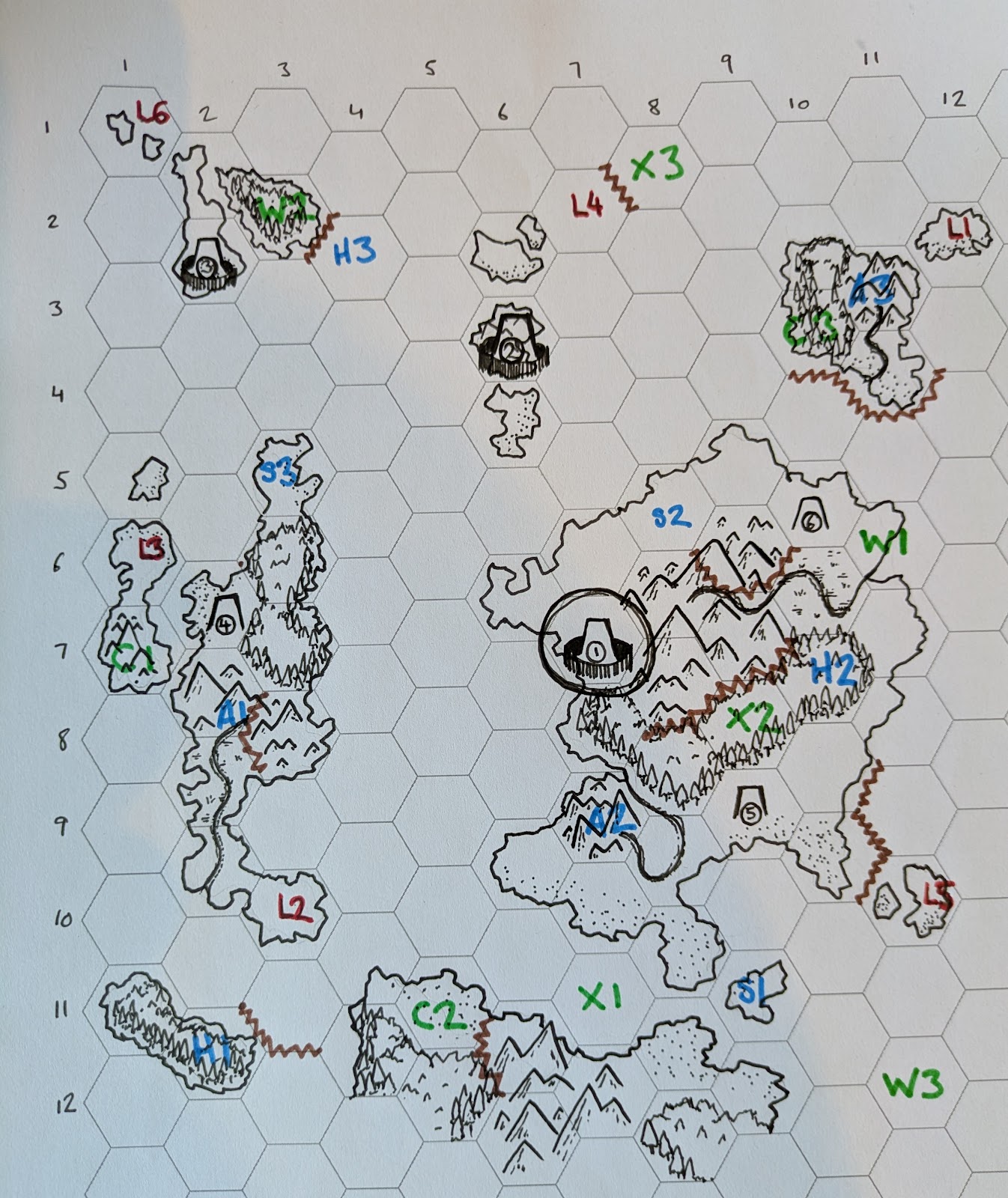
Here are the results I came up with following the procedure myself. This is the player facing map for The Storm Isles (since we've got full Character Creation and Legends for that Kingdom)!


The player-facing map shows just the terrain and Settlements (the numbered towers). The ref's map shows the locations of Legends and Features
Here's some accompanying notes for the keyed locations:

Settlements

1: Fort Stormbreak, the Capital, held by Clan Wavesplitter
2: Reivers' Return, stronghold of Clan Seawolf
3: Deepharbour, stronghold of Clan Darkwater
4: Dun Firinn, smallholding, held by Clan Arrowmender
5: Mirthall, smallholding, held by Clan Greenmoor
6: Windvale, smallholding, held Clan Thunderhawk

Legends

(Marked in Red)
L1: The Fire Fish
L2: The Grey Neighbours
L3: The Master Wyrm
L4: The Mound Dweller
L5: The Seal Hunter
L6: The Silver Tower

Strangers

(Marked in Blue)

    Hags
    H1: The Ossuary, home to The Bright Shell Hag
    H2: Grave of Whispers, home to The Doom Spear Hag
    H3: The Crystal Hollows, home to The Silver Horn Hag

    Abhainn
    A1: The Cold One's waterfall
    A2: The Nourishing One's shore
    A3: The Salmon River delta

    Shellcoats
    S1: Eyecoat, collector of heart whelks
    S2: Shinycoat, adorned with painted periwinkles
    S3: Smoothcoat, connoiseur of purple urchins

Sites

(Marked in Green)

    Crossings
    X1: Unicorn Falls
    X2: The Warrior's Stack
    X3: The Giant's Ford

    Cairns
    C1: Cairn of The Gloom Lord
    C2: Cairn of The Red Champion
    C3: Cairn of The Kelp Prophet

    Wasteland
    (Lands spoiled by the Blight of the dreaded Nuckelavee)
    W1: Reclaimed tower where mortals are stricken by The Hollowing Blight
    W2: Dead forest where trees have fallen to The Liquefying Blight
    W3: Dismantled bridge where the soil is tainted by The Blackening Blight

That's it for this one, We might take a look at expanding some of these basic notes next time!

Saturday, April 5, 2025

Fightin' Talk!

 I've had some time off which has allowed me to:

  • Take a relaxing holiday
  • Grow older
  • Make some progress with Legends of Alba
One of the things I've been meaning to try out on my own before taking the rules for a test-spin with players is combat. In the rules as they stand just now (which you can find here) combat is very simple. Like any other Test in the game it's a modified D20 Roll vs a Target number (Challenge). If you pass you deal a Wound, if you fail you suffer a Wound. So enemies don't roll, the Character's Test covers both sides of the conflict. The aim is to make combat fast and decisive so we have plenty of time in our sessions for other things to happen.

Combat Playtest

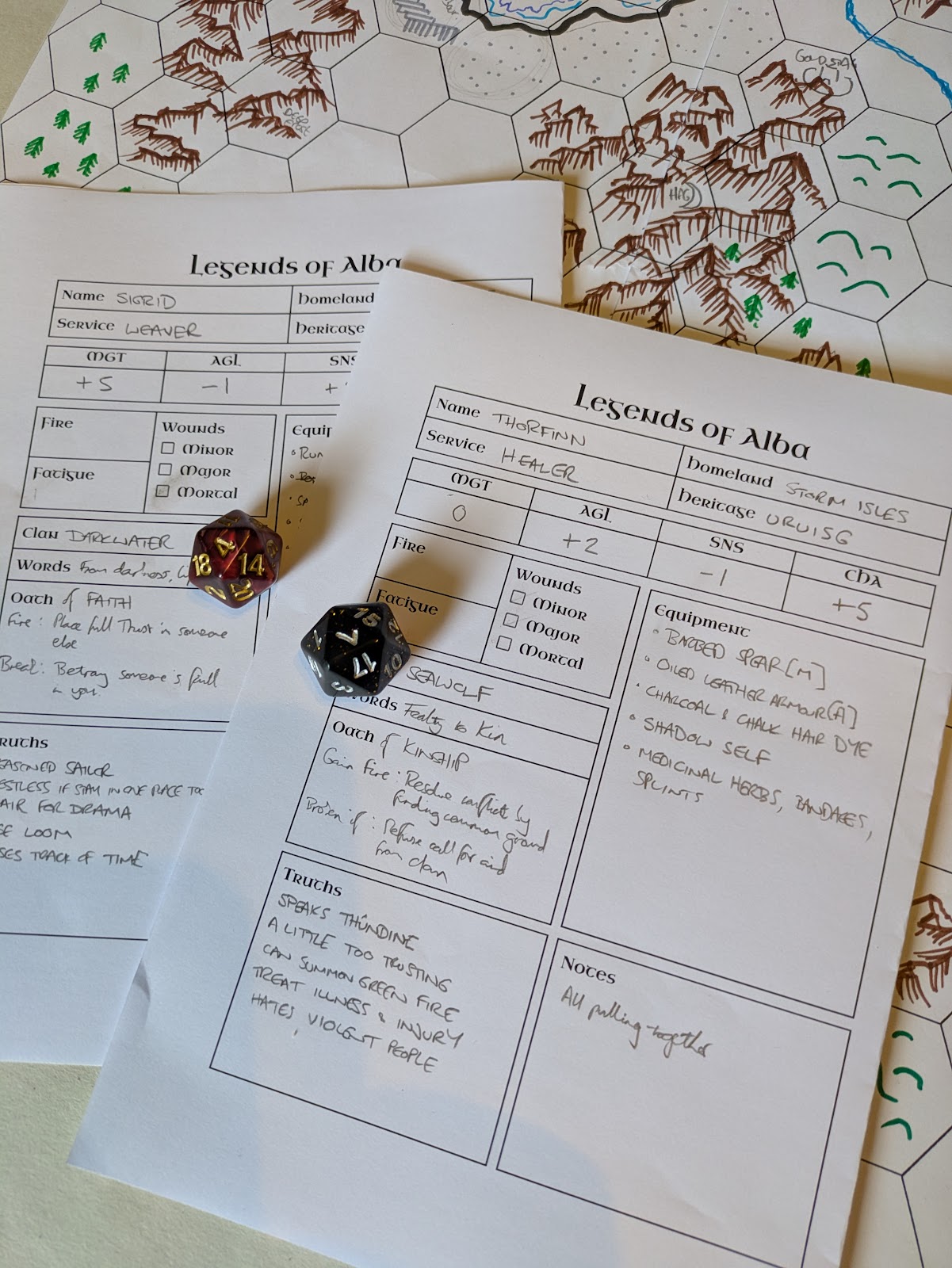
I thought I'd write up my notes from a very short Combat playtest. In this scenario we have 2 Characters, Thorfinn Seawolf and Sigrid Darkwater. They are travelling by land in the Storm Isles when they get attacked by 4 Muck Bogles! 

Muck Bogles are not too threatening a foe, so their Challenge is 10 (C10). I imagine they'd split their attacks between hurling dirt clods at Range, and good old fashioned fist-punching in Melee. Thorfinn and Sigrid ready themselves and leap into action!

Thorfinn & Sigrid vs The Muck Bogles

  • Round 1: Sigrid tightens her grip on her runic staff and strikes down one of the Bogles! Thorfinn doesn't fair so well, his barbed spear getting lodged in the Bogles mucky body, allowing it to strike back at him and deal a Minor Wound.
  • Round 2: Grumbling Thundine curses, Thorfinn frees his spear and takes out the Bogle that Wounded him. Sigrid's staff whistles through the air to take down a third.
  • Round 3: With a voice like thunder, Sigrid calls on the Might of Teran, God of Storms, to Help Thorfinn take down the final Bogle.
Victory for the Characters! They take a moment to let Thorfinn catch his breath, recovering from his Minor Wound before pressing on.

The following day they come across an alarming scene: The Crystal Wyrm attacking a crofting hamlet! Its huge form hangs in the air, pale and scaleless, embedded with glittering purple crystals. In its paranoia, it has come to believe these crofters have been conspiring against it. This is a desperate situation, The Crystal Wyrm is easily capable of delivering on this threat and worse, its Challenge is 25 (C25). Still, Thorfinn and Sigrid have heard the Covens' Call to answer The Legends - they have to do something. So here they go.

Thorfinn & Sigrid vs The Crystal Wyrm

  • Round 1: Thorfinn dives at the Wyrm's claw with his spear, only for it pull back and score a deep gash that opens his forearm - gah! A Major Wound! Sigrid gathers her strength and tries to shove the sharp end of her staff into the Wyrm's pale skin. This goes disastrously wrong, as the Wyrm blocks the attack with its crystalline tail, skewering Sigrid straight through the gut with one of its spines. A Mortal Wound: Sigrid is dying.
  • Round 2:  The situation has become dire - Thorfinn & Sigrid need to get out of there. They choose to Flee, leaving the crofters to their grim fate.
With Sigrid carrying a Mortal Wound she needs treatment or she will die. Thorfinn served the Seawolf Clan as a Healer but is in bad shape himself and this Wound is beyond his skill. They are currently two days' travel from Windvale, home of The Thunderhawk Clan. Its the nearest Settlement and so they make their way there in search of an expert healer. Thorfinn keeps Sigrid's Wound clean and dressed on the way, while she offers her homespun shawl to bind his arm. Together they make it to Windvale where they find care and rest.

Thoughts

Even though this was a very staged, hand-wavey test of the combat, it was immensely helpful. It was fast to resolve and still left plenty of room to paint a mental picture of the action based on the results of the dice rolls. I wanted to test both ends of the extreme in terms of Challenge and got pretty much the results I was expecting. The Characters easily bested the Bogles, whereas they were lucky to escape with their lives against The Wyrm. It also highlighted a few things to work on as well:
  • I had to add Rules on the fly for how to handle Mortal Wounds. The Character is dying, but what does that mean? Mechanically, I ruled that if you go to sleep with a Mortal Wound, you might not wake up. If anyone in the party is Mortally Wounded, healing should be their top priority.
  • It's my intention to add some random tables for Wounds so you can be specific. Thorfinn took a Major Wound to his forearm, which I just described for flavour. It might have been a Hindrance if he'd kept fighting though - whereas if he'd hurt his leg, that might have Hindered movement (arguably worse!)
  • I still need to add Rules for Fleeing combat. In my D&D games I've offered it as a party option which can be performed at the start of the Round if everyone agrees. The party get away, no Roll required, but suffer a narrative loss. I think it works just great!
That's it for now, till next time!

    Saturday, March 15, 2025

    Legends of The Storm Isles

    This is quite an exciting post as it marks a big step towards being able to run games of Legends of Alba using the rules and tools I've been working on through this blog!

    My aim is to have a ruleset that will allow players and a GM to run games set in The Storm Isles. This is Northernmost Kingdom of Alba, inspired predominantly by the geography and folklore of The Orkney Isles, but with an eye further North to Shetland and South to Caithness as well. If the rules work for The Storm Isles, I'll then look at fleshing out the other Kingdoms of Alba.

    The Character Creation preview allows players to create characters from The Storm Isles. The Legends meanwhile are the GM's primary tool for bringing the game to life. Each Legend is centred around a folk tale or mythical creature, and contains a set of encounters (called Augurs) for the players to discover as they explore the Kingdom, which they must resolve in answer to The Covens' Call. I'll be sharing the procedure for this in another post but it's pretty much the same as for encountering Omens of the Myths from Mythic Bastionland.

    You can read the first draft of The Legends of The Storm Isles here! Keep reading for some summary notes on the tales that inspired them.

    A Shetland Fishing Boat in Stormy Weather North of the Orkney Islands,
    Anton Melbye 1842, public domain from Picryl

    The Fire Fish - inspired by The Marool from Shetland, this was a giant many eyed fish with flaming fins, feared for its hunting of ships during stormy weather. I thought it would be interesting for my take on it to have this sea-monster pitted against an angler, obsessed with landing it, and see what the players make of it.

    The Grey Neighbours - The Trow are faerie-folk that feature prominently in Orcadian folklore. They're known for their love of music, and were attributed as sources of inspiration for musicians. I wanted this one to be a less adversarial Legend, but not without teeth. Could there be some unforeseen consequences to The Otherworldly inspiration of The Trow? The sleepless poet in this Legend might think so.

    The Master Wyrm - Asipattle and The Stoor Wyrm is one of the most famous Orkney tales. Here I've put the Mester Stoor Wyrm as the first of the Ancient Great Wyrms (the Legends of Alba versions of dragons) and Asipattle is only hinted at as a dimly recalled ancestor of The Cindersift Clan.

    The Mound Dweller - A take on the hog-boon by way of the film It Follows. The Mound Dwellers could be kindly spirits, but they were also guardians of the mounds they tended. Little kindness to be found here: Woe betide the witless thief that steals from a cairn protected by Haugbui!

    The Seal Hunter - The actual story of The Seal Hunter ends quite amicably after a seal hunter unwittingly wounds the Queen of The Selkies. I wondered what it might look like if she wasn't quite so cool with it. There's also a gang of Orca in here (since Killer Whales are excellent seal hunters!) based on the story of the Law of The Tongue. That story is actually from Australia but it's too good not to include.

    The Silver Tower - This started off as my take on the Finfolk. They were Storm Wizards who paddled around the seas in sealskin boats. I got an uncomfortable sense from the tales however that they originated from xenophobia towards the actual Fins and/or the Sami people. So stepping swiftly off that, I took the bare fiction as a jumping off point and now this is a weird Legend about metamorphosis. Enjoy!

    The Storm Kelpies - For each of The Kingdoms I want to feature a big overarching Legend that will play out over the top of the others, a "Big Bad" as opposed to a "Monster of The Week". For The Storm Isles this had to be The Nuckelavee, the skinless cyclopean sea centaurs, truly nightmarish creatures! As the players encounter the damage wrought by these horrors from the depths, they'll also encounter a Dark Prince of the Sith on a bizarre quest of his own to try and control the abyssal beasts. The resolution of this Legend will reveal The One Who Dreams of Storms. The one who, it is said, will be able to control the dreaded Nuckelavee...

    That's it for now, till next time!

    Saturday, January 11, 2025

    Creating an Otherworld Realm

    One of my Legends of Alba groups has just started their second foray into one of the realms of The Otherworld. I’ve been refining my process for creating these realms since their first one, so I’ve recently had the opportunity to put the latest version to use. I quite like where it has ended up, so thought I’d share it here, and walk through the process to create a brand new realm in this very post!

    Here is the Otherworld Creation process I’m following.  Let’s get started!

    Step 1. Name and Describe the Realm

    Results: Hope, Decay*, Whispering, River

    OK this is quite interesting. I like having hope and decay both in there, those are quite contrasting ideas. Is this place the River of Whispering Hope? Maybe the Whispering River of Decay? I think I’m going to go with The Whispering River of Hope. Though it runs through a dying land, those souls who have lost hope might seek the river to hear a whisper of the truth, so their journey may continue.

    * I originally rolled Roots for the nature element, but chose to re-roll this result because the realm I’ve just created for my players is called The Heath of Hateful Roots. I'd like to have something with a different natural element. It’s totally fine to re-roll or ignore results from these tables in pursuit of a spark of inspiration.

    Step 2: Create Locations

    Results: The Reaper’s Table, Mossy Stairs, Afflicted Tunnel, Infested Tower, Speaker’s Court, Pristine Barracks

    The Reaper’s Table - how sinister! A place for a gathering or a feast? A rotten banquet laid out on this table would certainly emphasise the decay aspect! Perhaps the Reaper is willing to impart information to anyone who joins them in their disgusting feast.

    The Mossy Stairs - I’d change the name to The Green Stair, but keep the fact that they are covered in moss. That suggests they are very old and seldom trod, so it’d be a challenge to climb them and claim the treasure that lies at the top.

    Afflicted Tunnel - Probably a dangerous place, maybe the source of the affliction is a real problem in this realm?

    Infested Tower - Another dangerous one I'd say! Is the owner of the tower still around? Maybe they are stuck inside, or they could even be the cause of the infestation.

    Speaker’s Court - A source of power in the realm. What sort of proclamations does this Speaker make? Being known as a Speaker contrasts nicely with the river being said to whisper.

    Pristine Barracks - This is a decaying land, so the presence of an order of warriors at a pristine barracks is interesting. Why are they pristine? Is it a mark of strict discipline? Are they magically so? Or perhaps they’ve never actually seen combat… I think these are good candidates for a wildcard faction, so whether they're enemies or allies would be up to the characters.

    Step 3: Populate the Realm

    Results:

    • Beast - jaded goose
    • Fuath - lizard, loch, laughter, strangling roots
    • Sith - merry princess, stardust, must marry a mortal

    Jaded Goose - I normally think of geese as being noisy and aggressive, so the idea of a fed up, sulking goose plays against this expectation. A couple of things to think about though - like why are they so jaded? And is this one goose or a flock?

    The Loch Lizard - Fuaths make great adversaries because they are driven by hatred, so they can be manipulated by the characters, or fought without inviting too much of a moral quandary. This giant reptile has scales like sodden bark, and claws that are gnarled and twisted like tree roots. It lives in a loch, perhaps a corrupted offshoot of the River that runs through this realm. If it hears so much of a hint of merriment it attacks the source, choking the life of it with its strangling root claws.

    The Merry Princess - I’ll admit I had to have a little think about this one. ‘The merry princess’ gives a clear description of a character but sounds lame as a title. I googled the etymology of merry, which led me to the old English word ‘myrige’, which sounded like it could be a name. So this character is instead known as Princess Myrige, The Unburdened Heart. Her skin is as the night sky glittering with starlight, and she seeks a mortal spouse.

    4) Create Magic Items

    Results: Vagabond’s, barbed, bow, wisdom

    Mashing these around I came up with: 

    The Barbed Bow  - arrows fired from this bow sprout barbed vines to entangle their target; and

    Vagabond’s Wisdom - bottle of strong, magic liquor, consume it to get drunk but you are guaranteed to find your way to a warm bed tonight.

    I made another round of rolls to get a third item:

    Results: Thief’s, whispering, flute, sight. 

    That led me to:

    The Flute of Whispering Insight - appears to make no sound, no matter how hard you blow. But play it somewhere you’ve never been before to have it whisper a truth about your surroundings that only you can hear.

    5) Make Connections

    This is the “Draw the rest of the f***ing owl” step of the process where everything magically fits together. I like to start by writing a heading for the realm. Then the locations beneath it. Then I can start placing inhabitants and magic items in the locations based on a combination of idea fragments, intuition and (if all else fails) randomness. So I get something like this:

    The Whispering River of Hope

    • The Speaker’s Court
      • Jaded Goose - why not have a goose in charge?
    • The Pristine Barracks
    • The Tunnel of the Afflicted
      • Princess Myrige, The Unburdened Heart - maybe the afflicted are sort of a cult that worships her?
    • The Infested Tower
      • The Loch Lizard - this is a tower on an island in the middle of the loch
      • The Barbed Bow - the barbs sort of tie in with the Lizard's strangling roots
    • The Green Stair
      • The Flute of Whispering Insight - not sure what this is doing here but I'll think of something
    • The Reaper’s Table
      • Vagabond’s Wisdom - it's liquor, so goes with the feast

    From here it gets a bit harder to walk through the process. I jump around between locations, characters, factions, zoom in and out to consider locales and the realm as a whole. The aim is to get to the point where the realm ‘emerges’. I should be able to picture it clearly when I think about it. Everywhere should at the very least have something interesting going on for the player characters to get involved with. You should feel free to make changes to your results, discard results or generate extra ones to help you reach something you can imagine more clearly.

    Here's where it got to when I decided to call it done.

    The Whispering River of Hope

    A wide, deep river runs through a stinking bog. Folk cower in waterlogged shanties, half-sunken amongst rotten trees and spongy moss. The river itself is clear and pure, and said to whisper truths that inspire hope in those who need it most.

    The Speaker’s Court

    Once a power in this realm, the old goose has gone deaf. Many years have passed since she last heard the river. Much of her time is given to silent sulking, indifferent to the tawdry depths of scandal and intrigue into which her once-proud court has sunk.

    • Her Eloquence The Speaker, jaded giant goose, wants to be left alone.
    • Vapid goose courtiers, want to know what everyone else is up to.

    The Immaculate Barracks

    A fortress of white stone. Knights in white plate mail practise archery and swordplay. They await orders from The Speaker. They have been waiting for some time.

    • The Immaculate Knight-Captain Arnol, forgetful, wants the best for his Knights
    • Immaculate Knights, constantly fussing over their weapons and armour, want to be in a real fight
    • Erudite squires, not enough to do, convinced this will change when they finally become knights

    The Tunnel of the Afflicted

    The Afflicted are those blessed by Princess Myrige, whose beautiful laughter issues from the bowels of her dank tunnel city. Her subjects are immortal beyond the bounds of flesh, their rotting bodies host to myriad invertebrate life and mycelia.

    • Princess Myrige, The Unburdened Heart. Her skin is as the night sky glittering with starlight. Light hearted, laughs easily and often. Refused her coronation and never looked back, wants to bless as many as she can so others can share in her freedom.
    • The Afflicted. Content in their loyal service, tenacious in their search for a mortal spouse for their beloved Princess.

    The Infested Tower

    Long ago the island sanctum of a forgotten druid was swallowed by the loch that once protected it. Now it is the lair of The Loch Lizard, infested with its filth. The vile Fuath offers The Barbed Bow to whoever puts an end to the Princesses insufferable mirth.

    • The Loch Lizard, Strangleclaw. Scales of sodden bark, claws gnarled and twisted like tree roots. Hates the sound of laughter.
    • The Lizard’s Filth, reeking mud clumps, vaguely sentient, hungry for mortal flesh.
    • The Barbed Bow - arrows fired from this bow sprout barbed vines that entangle the target.

    The Green Stair

    These stone steps once led to the seat of coronation, where the Kings and Queens of the realm were crowned. Forgotten by most and engulfed by moss, the seat at its peak lies empty, a strange flute is all that remains of the crown jewels.

    • Engulfing moss - deadly hazard to anyone climbing the stair
    • The Flute of Whispering Insight - appears to make no sound, no matter how hard you blow. Play it somewhere you’ve never been before to have it whisper a truth about your surroundings that only you can hear.

    The Reapers’ Table

    A spoiled banquet moulders on a great rectangular table. There are some empty seats, the rest filled by Reapers. Stymied by the longevity of The Afflicted, they recoup what they can from the souls of the bog folk. They offer a bottle of Vagabond’s Wisdom if their gratitude is earned.

    • Reapers, tall crow-headed soul collectors. Having grown tired of one another, the only thing they love more than their rancid grub is sharing it with good company. 
    • Vagabond’s Wisdom - strong, magic liquor, consume to get drunk but you are guaranteed to find your way to a warm bed tonight.

    Thursday, November 28, 2024

    Map Locations

    In this post I wrote about some strengths of Elden Ring’s map. Since then I’ve started a new Legends of Alba campaign (bringing us up to 3!), so I had a chance to revisit what goes into the hex map. This new game, like the others, is being run as a D&D 5E game. But the map doesn’t know that. So my hope is that this can inform the ref’s advice for creating a map for running their own games, as part of the Legends of Alba game rules.

    For this post I’m just going to write about the types of locations that go on the map.

    Legends

    Pretty important in a game named Legends of Alba, these are the source of The Legends. When the players have a random encounter while travelling, the closest Legend Hex determines what this is. So if the players are closest to the Kelpie’s hex, they might encounter a rough river crossing with a white horse drinking there. The horse kneels, inviting them onto its back…


    Settlements

    1 Capital, a fortress city where the Kingdom monarch reigns. 2-3 Strongholds, hill forts of the Great Clans. And 2-3 Smallholdings, humbler homes to minor Clans. Settlements are places for the Characters to seek hospitality, local information and lore, and trade. They are also political hotbeds as there is always drama between and within the Clans - there’s plenty of opportunity here for the players to get involved to start making and breaking alliances to their advantage.

    Anti-Canon

    I don't plan to include a full 'History' section in Legends of Alba. Currently this is about as much as I want to include:  Befo...