s you can perform to gain 'tokens') and Strong Moves (helpful actions you can perform which require and use 'tokens'). Really like this as a design space to explore!
Tuesday, September 16, 2025
Tabletop Scotland 2025
s you can perform to gain 'tokens') and Strong Moves (helpful actions you can perform which require and use 'tokens'). Really like this as a design space to explore!
Tuesday, August 26, 2025
Inspiration: The Buried Giant
Kazuo Ishiguro's mythic fantasy tale takes place in an imagined past, in which a strange mist has settled over the British Isles, causing everyone to lose their memories. The story follows an elderly couple named Axl and Beatrice who set out from the safety of their underground village in search of their adult son. Dangers await them in the form of monsters and strange folk roaming the wilds. They also find allies in a Saxon warrior named Wistan and in Sir Gawain, the last knight of King Arthur's court. Axl & Beatrice's journey to reach their son's village leads them to discover the true nature of the mist itself, and puts them in the position to bring about an end to it. As they come closer to achieving this, we are invited to consider along with them what it means to remember and to forget, to hold on and to let go, to persevere and to resign.
I loved this story. Ishiguro’s clear and simple language leads you confidently through the tale. There’s a care and gentleness to his storytelling which (as with Never Let Me Go) does nothing to detract from the hardship or distress of the events being described. He also tackles the mythic fantasy genre as faithfully and yet innovatively as his treatment of the Kafkaesque in The Unconsoled. Much of the world is discovered by characters asking questions of one another, lending a dream-like quality to the landscape as it emerges from the mists. Characters are met along the way who seem familiar and yet are not decisively revealed as a new or returning character, hinting at the narrative warping of stories told and retold through oral tradition till they are written down at last. This occurs even between characters in the story, with both Wistan and Sir Gawain recalling memories of Axl himself that might not quite align but equally could both be true. Archetypes too are well used, with Knights, Hags and Ogres simultaneously subverted and permitted to resonate with their forebears in every story that’s come before. Achieving this balance of the vague yet evocative is extremely hard to do without plunging an exciting tale into the realm of inconsequential, disjointed nonsense - and it’s struck perfectly here.
A key component of this balance is the anchor of Axl and Beatrice throughout. One of the most compelling elements of their journey is the early-asked question of whether love can exist without the anchor of memory. They are tested by doubt and fear throughout, and when presented with the path to dispel the mist and regain their memories, have quite different views on whether they should. It is telling on both their characters that Axl, afraid to confront their memories since they seem content in their present, refers constantly to his wife as ‘princess’ while Beatrice, desperate to remember what’s been lost, no matter what it is, calls Axl ‘husband’. Axl, though fearful of the past, still lives firmly in it. Beatrice meanwhile, though suffering far more from the physical frailties of age, shows perhaps a greater strength here.
They do however have faith in their promise to one another, not only to find their son, but in their commitment to one another. This, together with their moment to moment kindness to one another, account for some of the most touching scenes in the book. In the face of their fading memories, Axl and Beatrice’s love learns to live in the active present and potential future.
As a shadow to this love at the centre of the story, there is a pervasive sense of ending. The faded grandeur of Sir Gawain, the frailty of Axl and Beatrice themselves, the giant cairns that loom from the mist: It’s a story that is saying goodbye. Goodbye to the last remnants of magic in the world, goodbye to the Britain that came before Britain, perhaps even a goodbye to life itself. Somehow even this darker element landed for me as a life affirming one because even with the sense of loss, there is one of acceptance and dignity. There's a natural order of things at work here. Standing in the way of that, clinging on to what should be let go, can only lead to the wasteland. The ending, though ambiguous (perhaps even because of its ambiguity), has stuck with me since I finished reading. It’s one that I truly hope does not fade into the mists.
Till next time!
Wednesday, August 6, 2025
Mythic Bastionland Without Knights?
![]() |
| The Mester Stoor Worm, from my copy of "The Lore of Scotland", Westwood & Kingshill |
Clans instead of Knights
Hags instead of Seers
Just Works?
Thursday, July 24, 2025
Ancient Power Vacuum
An era of ancient history I find endlessly interesting is The Wars of the Diadochi: A time of big battles and even bigger egos. Alexander The Great conquered the known world and then died suddenly and mysteriously, leaving no one in charge. The following decades saw his empire tear itself apart as his Successors pressed their claim to rule. It's a time of skyrocketing ambition, doomed nostalgia, desperate survival, hero-worship and emulation, murderous intrigue and truly massive pitched battles. There's no holds barred. There's everything to play for, everything to lose and, of course, so much is lost.
![]() |
| Alexander Sarcophagus, CC James Carnehan https://www.worldhistory.org/image/2918/alexander-sarcophagus/ |
A power vacuum is a great situation for an RPG isn't it? It's volatile, charged with potential energy and possibility for impactful change. Whether it's the main focus or a background element it gives players unprecedented opportunities and interesting choices to make, which is always valuable!
The Wars of The Successors provides some great inspiration for who might step forward when the Ruler of the Realm suddenly drops out of the picture.
I have the Throne
The thing about a seat of power is that, once someone is sitting in it, it's very hard to move them if they don't want to be moved. Antipater had been appointed as Regent of Macedonia And Greece, ruling the home countries while Alexander was off conquering the world. In other words he was sitting in the seat Alexander might have been expected to one day return to. The seat that now had many envious eyes on it.
I have the Right
The members of Alexander's Companion Cavalry (his honour guard) each considered themselves First Among Equals, bearing a sense of entitlement that they might succeed their King. In the case of Perdiccas, this stemmed from his tenure as second in command, having served Alexander since the beginning and been gifted with his signet ring. Surely such a clear favourite had the right to rule?
I have the Heir
Roxana's life as a Persian Princess had already taken a sharp turn when Persia was conquered by Alexander. At the time of his death she was married to him and pregnant with his child. She'd travelled with him on campaign and made both enemies and friends among his Generals, those who now squabbled over the empire. She knew her unborn son could not be ignored.
I have the Body
What better way to cement your claim to the crown than by burying the old King? In one of the more wacky plots of this period, Ptolemy stole Alexander's body to have it brought to him in Egypt for a proper funeral.
I have the Army
The Silver Shields were the veteran infantry, hardened soldiers of Alexander's long campaign of military subjugation. Whoever could call on them wielded not only a fearsome weapon of war, but their famous reputation to match. They were also a liability, being a turbulent bunch who, when it came down to it, valued the treasure they'd won in their 40 years of warfare over any ideas of loyalty (No judgement here, that's a lot of treasure!).
I have the People
I don't have a historical example to point to for this one (maybe it says something about this time period that 'the people' suffering under all this fighting are seldom mentioned? If ever?!) but a people's champion would certainly be an interesting addition to the mix here either as a sympathetic candidate or (another) villainous one!
That's it for now, till next time!
Saturday, July 12, 2025
No Hit Points? No Problem!
Following on from the very rough combat playtest I did in April, I’ve been having a think about how to handle Wounds in Legends of Alba. Characters don't have HP in this game, but they can take Wounds! I’m trying to keep the game light (in terms of rules) but it feels just a bit too vague to say a Character has a Major Wound, or a Mortal Wound, and leave it at that. How has the Character been Wounded? Cracked skull? Stabbed in the guts? Lost a finger?
Thinking about how I’d run this, as a referee I think I’d have a hard time improvising something. I’d worry about it feeling vindictive if I interpreted a Mortal Wound at the table as “Your leg is broken, there’s bone sticking out - you need treatment soon and even then you might lose the leg.” I think dire consequences like that should be possible for Mortal Wounds, but personally I’d need a nudge from the game to follow through with it.
![]() |
| The Death of Olaf by Joseph Freely |
I thought about Wounds as temporary or permanent Truths e.g. “Your hands tremble” to reflect a traumatic Wound, or “You move slowly and carefully” for a fragile Wound that’s still healing. But these are so specific, I’d need a big table to give a good range of them, and I don’t want Wounds to take up a whole page on their own. I still quite like this idea of Truths applied like this though, I could see using this for unique magic weapons or items.
What I’ve settled on for now is this D12 spark table:
| D12 | What | Where |
|---|---|---|
| 1 | Torn | Skull |
| 2 | Ruptured | Eye |
| 3 | Fractured | Jaw or Nose |
| 4 | Crushed | Spine |
| 5 | Pierced | Ribs |
| 6 | Gouged | Gut |
| 7 | Cracked | Shoulder |
| 8 | Severed | Arm |
| 9 | Split | Hand or Finger |
| 10 | Maimed | Thigh |
| 11 | Bruised | Knee |
| 12 | Sliced | Foot or Toe |
Now here comes the pain!
Let’s roll up a Minor Wound, a 5 and a 6: Pierced Gut. A close call but the sharp pain quickly subsides, thankfully it’s not too deep and hasn’t punctured anything vital.
For a Major Wound it’s a 4 and a 12: Crushed Foot or Toe. Major Wounds are a bit more severe so let’s crush a foot rather than a toe. It’s not going to kill you but you’re going to have trouble putting any weight on it, and might end up with a permanent limp if you don’t get it seen to to get the bones set and rest up. This would definitely cause a Hindrance for Tests that involve moving quickly or nimbly on foot. There’s of course the opportunity for Characters to mitigate this if they have a mount or something they can use as a crutch.
Lastly a Mortal Wound, a 10 and a 6: Maimed Ribs. Oh dear. This sounds like it’d be an horrific mess. A crippling chest wound that steals away your breath. Probably a Hindrance to most things requiring any sustained physical effort. You might live if you get help but because this is a Mortal Wound we’re going to apply the most unforgiving definition of the maimed result, i.e. an injury so bad that the injured part no longer works properly. So best outcome for this Character might be that they gain a Truth “You struggle to lift heavy items” to represent this wound that never properly healed.
What a grisly affair. I’m happy enough with this for now though, and more than happy to move on from thinking about these horrible things happening to the heroes of Alba for a while!
Thursday, May 15, 2025
Weird Bones
Something a bit different: Skeletons are one of my favourite types of enemy to throw at players in an RPG. I thought it would be fun to think about a few different takes on the skeleton, so roll a D6 and see what rises from the crypt!
![]() |
| Crisóstomo MartÃnez, CC by 4.0 from lookandlearn.com |
D6 Weird Bones
Saturday, May 10, 2025
Building a Kingdom of Alba
I've been working on a guide for referees to build their own Kingdom of Alba, which is now in a state that I can share it here! Check it out and discover how to go about Building The Kingdom for a game of Legends of Alba.
There's a couple of dependant documents which I've not written up properly yet (the pages for Crossings and Cairns refer to separate guidelines for creating an Otherworld Realm and a Barrowdeep Delve - I have some WIP for creating Otherworld Realms but haven't covered the Barrowdeeps yet) but there's enough to produce the map and background details.
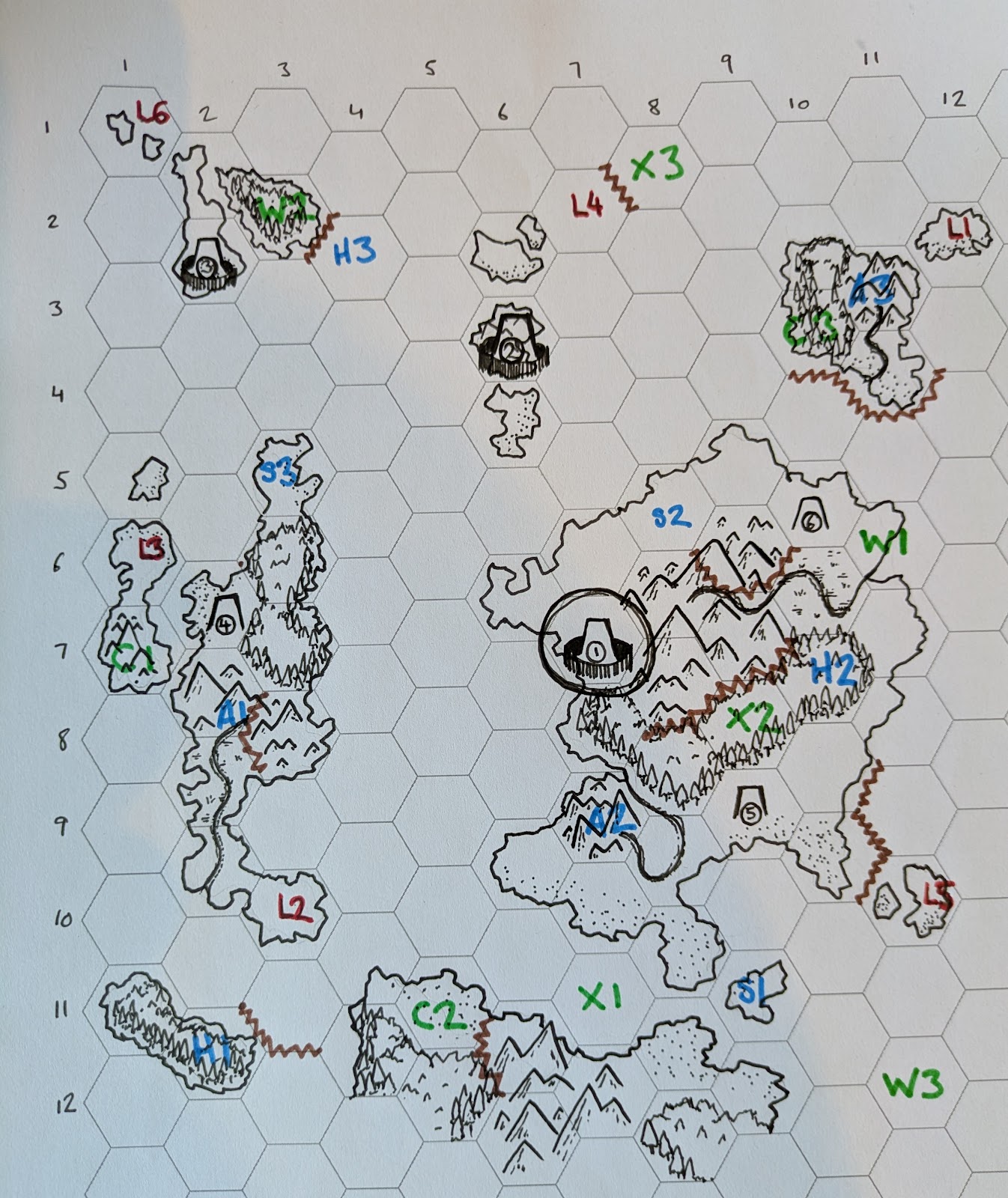
Here are the results I came up with following the procedure myself. This is the player facing map for The Storm Isles (since we've got full Character Creation and Legends for that Kingdom)!
The player-facing map shows just the terrain and Settlements (the numbered towers). The ref's map shows the locations of Legends and FeaturesHere's some accompanying notes for the keyed locations:
Settlements
2: Reivers' Return, stronghold of Clan Seawolf
4: Dun Firinn, smallholding, held by Clan Arrowmender
5: Mirthall, smallholding, held by Clan Greenmoor
6: Windvale, smallholding, held Clan Thunderhawk
Legends
Strangers
Sites
Anti-Canon
I don't plan to include a full 'History' section in Legends of Alba. Currently this is about as much as I want to include: Befo...
-
Approaching The House I'm a massive horror and weird-fiction fan but I did not discover Mark Z. Danielewski's novel House of Leaves ...
-
A couple of months ago I wrote about Custom Backgrounds , what a difference they can make to 5E games, and what they might look like for the...
-
One of my intentions for this year has been to get back into a writing habit. How's that been going? Mixed. I've been doing some w...