Tuesday, August 26, 2025

Inspiration: The Buried Giant

Kazuo Ishiguro's mythic fantasy tale takes place in an imagined past, in which a strange mist has settled over the British Isles, causing everyone to lose their memories. The story follows an elderly couple named Axl and Beatrice who set out from the safety of their underground village in search of their adult son. Dangers await them in the form of monsters and strange folk roaming the wilds. They also find allies in a Saxon warrior named Wistan and in Sir Gawain, the last knight of King Arthur's court. Axl & Beatrice's journey to reach their son's village leads them to discover the true nature of the mist itself, and puts them in the position to bring about an end to it. As they come closer to achieving this, we are invited to consider along with them what it means to remember and to forget, to hold on and to let go, to persevere and to resign.

I loved this story. Ishiguro’s clear and simple language leads you confidently through the tale. There’s a care and gentleness to his storytelling which (as with Never Let Me Go) does nothing to detract from the hardship or distress of the events being described. He also tackles the mythic fantasy genre as faithfully and yet innovatively as his treatment of the Kafkaesque in The Unconsoled. Much of the world is discovered by characters asking questions of one another, lending a dream-like quality to the landscape as it emerges from the mists. Characters are met along the way who seem familiar and yet are not decisively revealed as a new or returning character, hinting at the narrative warping of stories told and retold through oral tradition till they are written down at last. This occurs even between characters in the story, with both Wistan and Sir Gawain recalling memories of Axl himself that might not quite align but equally could both be true. Archetypes too are well used, with Knights, Hags and Ogres simultaneously subverted and permitted to resonate with their forebears in every story that’s come before. Achieving this balance of the vague yet evocative is extremely hard to do without plunging an exciting tale into the realm of inconsequential, disjointed nonsense - and it’s struck perfectly here. 

A key component of this balance is the anchor of Axl and Beatrice throughout. One of the most compelling elements of their journey is the early-asked question of whether love can exist without the anchor of memory. They are tested by doubt and fear throughout, and when presented with the path to dispel the mist and regain their memories, have quite different views on whether they should. It is telling on both their characters that Axl, afraid to confront their memories since they seem content in their present, refers constantly to his wife as ‘princess’ while Beatrice, desperate to remember what’s been lost, no matter what it is, calls Axl ‘husband’. Axl, though fearful of the past, still lives firmly in it. Beatrice meanwhile, though suffering far more from the physical frailties of age, shows perhaps a greater strength here.

They do however have faith in their promise to one another, not only to find their son, but in their commitment to one another. This, together with their moment to moment kindness to one another, account for some of the most touching scenes in the book. In the face of their fading memories, Axl and Beatrice’s love learns to live in the active present and potential future.

As a shadow to this love at the centre of the story, there is a pervasive sense of ending. The faded grandeur of Sir Gawain, the frailty of Axl and Beatrice themselves, the giant cairns that loom from the mist: It’s a story that is saying goodbye. Goodbye to the last remnants of magic in the world, goodbye to the Britain that came before Britain, perhaps even a goodbye to life itself. Somehow even this darker element landed for me as a life affirming one because even with the sense of loss, there is one of acceptance and dignity. There's a natural order of things at work here. Standing in the way of that, clinging on to what should be let go, can only lead to the wasteland. The ending, though ambiguous (perhaps even because of its ambiguity), has stuck with me since I finished reading. It’s one that I truly hope does not fade into the mists.

Till next time!

Wednesday, August 6, 2025

Mythic Bastionland Without Knights?

I’ve been running games in the Legends of Alba setting since January last year. Under the hood of these ostensibly 5e games though, the engine that has been doing the real work has been the World Prep and Travel procedures from Mythic Bastionland. These are excellent - they’re lightweight and evocative and I find them intuitive to run. The game has been at its best when the player characters have been journeying between destinations on the Kingdom map, encountering the Augurs of the Legends, seeking out Hags for advice, or negotiating clan politics. Seek the Myths, Honor the Seers, Protect the Realm… where have I heard that before?

The Mester Stoor Worm,
from my copy of "The Lore of Scotland",
Westwood & Kingshill


Taking stock of where I’m at with Legends of Alba as a project, I’m reconsidering whether this setting might best be expressed as a ‘module’ for Mythic Bastionland. If I wrote up the Clans like Knights, and the Legends as Myths (which they pretty much are already), would that ‘just work’?

Let’s see. What needs to change?

Clans instead of Knights

Player Characters are called from the clans to answer the Legends. The clans are also effectively the NPC factions that the Characters will be dealing with. Clans are ruled by Chiefs. Druids advise the Chiefs in terms of The Law of The Land, Bards chronicle and spread word of a Chief’s deeds, while Warriors lead their warband. 

 Knights in MB are expected to uphold their Oaths, which elevates them from the vassals but places a burden of responsibility upon them. There’s a great line in the book that they ‘rely on their arms, but are expected to know the customs of peace’. 

The clans of Alba meanwhile are all about finding the balance between civilization and nature. They are dependent on their harsh but beautiful land for survival. They also walk a line between prioritising the self and the community, embodied by the Chiefs, whose ambition can get the better of their sense of duty. 

Hags instead of Seers

The Seers are one of my favourite parts of MB, but are more morally ambiguous than the Hags of Alba. Both fulfil an important role - a hermit that players can seek out for information that not everyone has access to. But while the Seers are intended to provide an optional extra level of conflict to the game (their motivations are not always aligned to the PCs), the Hags of Alba embody the link between mortal folk and The Otherworld, as they have one foot in each. Like Seers, they are able to glimpse the past, present and future, making their advice tend towards the cryptic. But what they offer is Truth to those who seek it, and they aim to steer mortals towards equilibrium with the land and, by extension, The Otherworld.

Just Works?

So if we take Mythic Bastionland and swap Knights, Seers, Myths and The City for Clans, Hags, Legends and The Otherworld, do we get Legends of Alba? And are those two meaningfully distinct? To the first, I think so. To the second, I hope so! I had a go at writing up one Clan and one Legend just to try it on for size. It was good fun, so at the moment I’m thinking it would be worth writing more. If I can get up to 12 Clans and 12 Legends, that’d be enough for a test game I think! 

 Till next time!

Thursday, July 24, 2025

Ancient Power Vacuum

An era of ancient history I find endlessly interesting is The Wars of the Diadochi: A time of big battles and even bigger egos. Alexander The Great conquered the known world and then died suddenly and mysteriously, leaving no one in charge. The following decades saw his empire tear itself apart as his Successors pressed their claim to rule. It's a time of skyrocketing ambition, doomed nostalgia, desperate survival, hero-worship and emulation, murderous intrigue and truly massive pitched battles. There's no holds barred. There's everything to play for, everything to lose and, of course, so much is lost.

Alexander Sarcophagus, CC James Carnehan
https://www.worldhistory.org/image/2918/alexander-sarcophagus/

A power vacuum is a great situation for an RPG isn't it? It's volatile, charged with potential energy and possibility for impactful change. Whether it's the main focus or a background element it gives players unprecedented opportunities and interesting choices to make, which is always valuable!

The Wars of The Successors provides some great inspiration for who might step forward when the Ruler of the Realm suddenly drops out of the picture.

I have the Throne

The thing about a seat of power is that, once someone is sitting in it, it's very hard to move them if they don't want to be moved. Antipater had been appointed as Regent of Macedonia And Greece, ruling the home countries while Alexander was off conquering the world. In other words he was sitting in the seat Alexander might have been expected to one day return to. The seat that now had many envious eyes on it.

I have the Right

The members of Alexander's Companion Cavalry (his honour guard) each considered themselves First Among Equals, bearing a sense of entitlement that they might succeed their King. In the case of Perdiccas, this stemmed from his tenure as second in command, having served Alexander since the beginning and been gifted with his signet ring. Surely such a clear favourite had the right to rule?

I have the Heir

Roxana's life as a Persian Princess had already taken a sharp turn when Persia was conquered by Alexander. At the time of his death she was married to him and pregnant with his child. She'd travelled with him on campaign and made both enemies and friends among his Generals, those who now squabbled over the empire. She knew her unborn son could not be ignored.

I have the Body

What better way to cement your claim to the crown than by burying the old King? In one of the more wacky plots of this period, Ptolemy stole Alexander's body to have it brought to him in Egypt for a proper funeral.

I have the Army

The Silver Shields were the veteran infantry, hardened soldiers of Alexander's long campaign of military subjugation. Whoever could call on them wielded not only a fearsome weapon of war, but their famous reputation to match. They were also a liability, being a turbulent bunch who, when it came down to it, valued the treasure they'd won in their 40 years of warfare over any ideas of loyalty (No judgement here, that's a lot of treasure!).

I have the People

I don't have a historical example to point to for this one (maybe it says something about this time period that 'the people' suffering under all this fighting are seldom mentioned? If ever?!) but a people's champion would certainly be an interesting addition to the mix here either as a sympathetic candidate or (another) villainous one!

That's it for now, till next time!


Saturday, July 12, 2025

No Hit Points? No Problem!

Following on from the very rough combat playtest I did in April, I’ve been having a think about how to handle Wounds in Legends of Alba. Characters don't have HP in this game, but they can take Wounds! I’m trying to keep the game light (in terms of rules) but it feels just a bit too vague to say a Character has a Major Wound, or a Mortal Wound, and leave it at that. How has the Character been Wounded? Cracked skull? Stabbed in the guts? Lost a finger?

Thinking about how I’d run this, as a referee I think I’d have a hard time improvising something. I’d worry about it feeling vindictive if I interpreted a Mortal Wound at the table as “Your leg is broken, there’s bone sticking out - you need treatment soon and even then you might lose the leg.” I think dire consequences like that should be possible for Mortal Wounds, but personally I’d need a nudge from the game to follow through with it.

The Death of Olaf by Joseph Freely

I thought about Wounds as temporary or permanent Truths e.g. “Your hands tremble” to reflect a traumatic Wound, or “You move slowly and carefully” for a fragile Wound that’s still healing. But these are so specific, I’d need a big table to give a good range of them, and I don’t want Wounds to take up a whole page on their own. I still quite like this idea of Truths applied like this though, I could see using this for unique magic weapons or items.

What I’ve settled on for now is this D12 spark table:

D12 What Where
1 Torn Skull
2 Ruptured Eye
3 Fractured Jaw or Nose
4 Crushed Spine
5 Pierced Ribs
6 Gouged Gut
7 Cracked Shoulder
8 Severed Arm
9 Split Hand or Finger
10 Maimed Thigh
11 Bruised Knee
12 Sliced Foot or Toe

Now here comes the pain!

Let’s roll up a Minor Wound, a 5 and a 6: Pierced Gut. A close call but the sharp pain quickly subsides, thankfully it’s not too deep and hasn’t punctured anything vital.

For a Major Wound it’s a 4 and a 12: Crushed Foot or Toe. Major Wounds are a bit more severe so let’s crush a foot rather than a toe. It’s not going to kill you but you’re going to have trouble putting any weight on it, and might end up with a permanent limp if you don’t get it seen to to get the bones set and rest up. This would definitely cause a Hindrance for Tests that involve moving quickly or nimbly on foot. There’s of course the opportunity for Characters to mitigate this if they have a mount or something they can use as a crutch.

Lastly a Mortal Wound, a 10 and a 6: Maimed Ribs. Oh dear. This sounds like it’d be an horrific mess. A crippling chest wound that steals away your breath. Probably a Hindrance to most things requiring any sustained physical effort. You might live if you get help but because this is a Mortal Wound we’re going to apply the most unforgiving definition of the maimed result, i.e. an injury so bad that the injured part no longer works properly. So best outcome for this Character might be that they gain a Truth “You struggle to lift heavy items” to represent this wound that never properly healed.

What a grisly affair. I’m happy enough with this for now though, and more than happy to move on from thinking about these horrible things happening to the heroes of Alba for a while!

Till next time!

Thursday, May 15, 2025

Weird Bones

Something a bit different: Skeletons are one of my favourite types of enemy to throw at players in an RPG. I thought it would be fun to think about a few different takes on the skeleton, so roll a D6 and see what rises from the crypt!

Crisóstomo Martínez, CC by 4.0
from lookandlearn.com

D6 Weird Bones

1. Blood Bones - a thirst for violence that did not end in death. Their frenzy is contagious: Those who fight them might find themselves unburdened of any compulsion to observe the traditional cessation of hostilities that typically follows the defeat of an enemy.

2. Muddle Bones - there is an excitable curiosity sometimes found amongst academics that leads to a blurring of the lines between experimentation and just messing about. The study of necromancy is no exception: If a student bone-shaper were to swap the skulls of a wolf and a sheep skeleton for what they deemed a laugh, or replace the arms of a human skeleton with an additional set of legs and be delighted by their cartwheeling creation, they would be neither the first nor the last. 

3. Dry Bones - bodyguards and priests of powerful mages, bound by oaths or curses to protect their masters for eternity. The job is mostly lying around in an unassuming pile until a foolish adventurer trips over you.

4. Moss Bones - we’ve all pondered the thought experiment about the mop: If you replace the handle and then later replace the head, is it the same mop? But what about if you, as a sentient being, come into contact with that rare type of moss that grows on your skin, gradually eating away at it, replacing it with more moss? What if over time it eats all of your skin and organs, until eventually you are a skeleton covered in thinking moss? Are you still the same sentient being?

5. Frost Bones - those who clung to life against the bitter cold, enough to impress The Cold Ones themselves and be given a second chance. They no longer have empathy in their hearts for the living, but they do have jagged shards of ice that crystallize around their shoulders and forearms, which can be cast off like projectiles.

6. Iron Bones - it is almost impossible to destroy a skeleton made of iron. With so much time on their hands, existential ennui is their greatest enemy. So Iron Bones tend to go one of two ways: Either they find meaning in an unusual hobby; or they embrace nihilism (as much as one can) and become sellswords.

Till next time!

Saturday, May 10, 2025

Building a Kingdom of Alba

I've been working on a guide for referees to build their own Kingdom of Alba, which is now in a state that I can share it here! Check it out and discover how to go about Building The Kingdom for a game of Legends of Alba.

There's a couple of dependant documents which I've not written up properly yet (the pages for Crossings and Cairns refer to separate guidelines for creating an Otherworld Realm and a Barrowdeep Delve - I have some WIP for creating Otherworld Realms but haven't covered the Barrowdeeps yet) but there's enough to produce the map and background details.

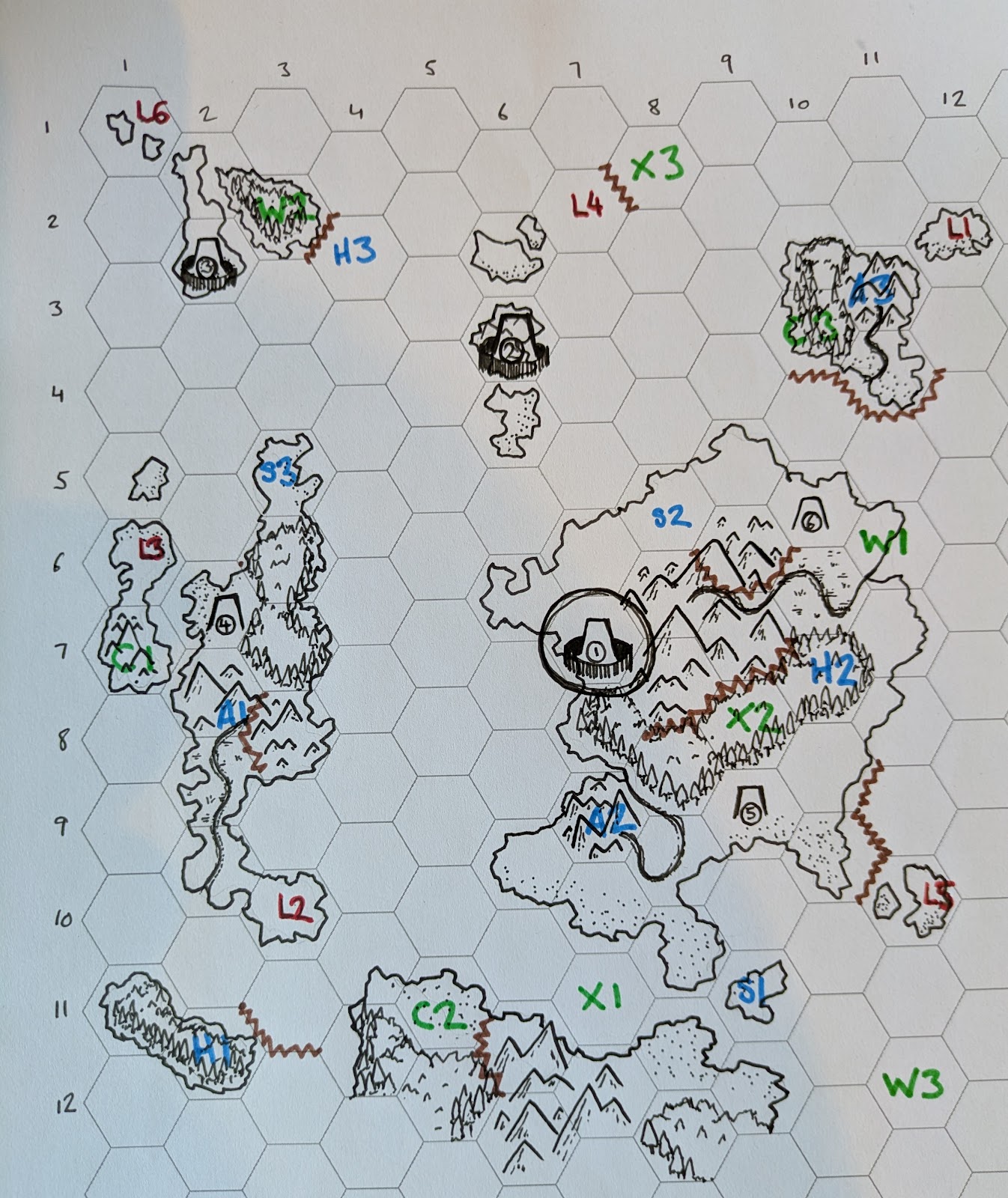
Here are the results I came up with following the procedure myself. This is the player facing map for The Storm Isles (since we've got full Character Creation and Legends for that Kingdom)!


The player-facing map shows just the terrain and Settlements (the numbered towers). The ref's map shows the locations of Legends and Features
Here's some accompanying notes for the keyed locations:

Settlements

1: Fort Stormbreak, the Capital, held by Clan Wavesplitter
2: Reivers' Return, stronghold of Clan Seawolf
3: Deepharbour, stronghold of Clan Darkwater
4: Dun Firinn, smallholding, held by Clan Arrowmender
5: Mirthall, smallholding, held by Clan Greenmoor
6: Windvale, smallholding, held Clan Thunderhawk

Legends

(Marked in Red)
L1: The Fire Fish
L2: The Grey Neighbours
L3: The Master Wyrm
L4: The Mound Dweller
L5: The Seal Hunter
L6: The Silver Tower

Strangers

(Marked in Blue)

    Hags
    H1: The Ossuary, home to The Bright Shell Hag
    H2: Grave of Whispers, home to The Doom Spear Hag
    H3: The Crystal Hollows, home to The Silver Horn Hag

    Abhainn
    A1: The Cold One's waterfall
    A2: The Nourishing One's shore
    A3: The Salmon River delta

    Shellcoats
    S1: Eyecoat, collector of heart whelks
    S2: Shinycoat, adorned with painted periwinkles
    S3: Smoothcoat, connoiseur of purple urchins

Sites

(Marked in Green)

    Crossings
    X1: Unicorn Falls
    X2: The Warrior's Stack
    X3: The Giant's Ford

    Cairns
    C1: Cairn of The Gloom Lord
    C2: Cairn of The Red Champion
    C3: Cairn of The Kelp Prophet

    Wasteland
    (Lands spoiled by the Blight of the dreaded Nuckelavee)
    W1: Reclaimed tower where mortals are stricken by The Hollowing Blight
    W2: Dead forest where trees have fallen to The Liquefying Blight
    W3: Dismantled bridge where the soil is tainted by The Blackening Blight

That's it for this one, We might take a look at expanding some of these basic notes next time!

Saturday, April 5, 2025

Fightin' Talk!

 I've had some time off which has allowed me to:

  • Take a relaxing holiday
  • Grow older
  • Make some progress with Legends of Alba
One of the things I've been meaning to try out on my own before taking the rules for a test-spin with players is combat. In the rules as they stand just now (which you can find here) combat is very simple. Like any other Test in the game it's a modified D20 Roll vs a Target number (Challenge). If you pass you deal a Wound, if you fail you suffer a Wound. So enemies don't roll, the Character's Test covers both sides of the conflict. The aim is to make combat fast and decisive so we have plenty of time in our sessions for other things to happen.

Combat Playtest

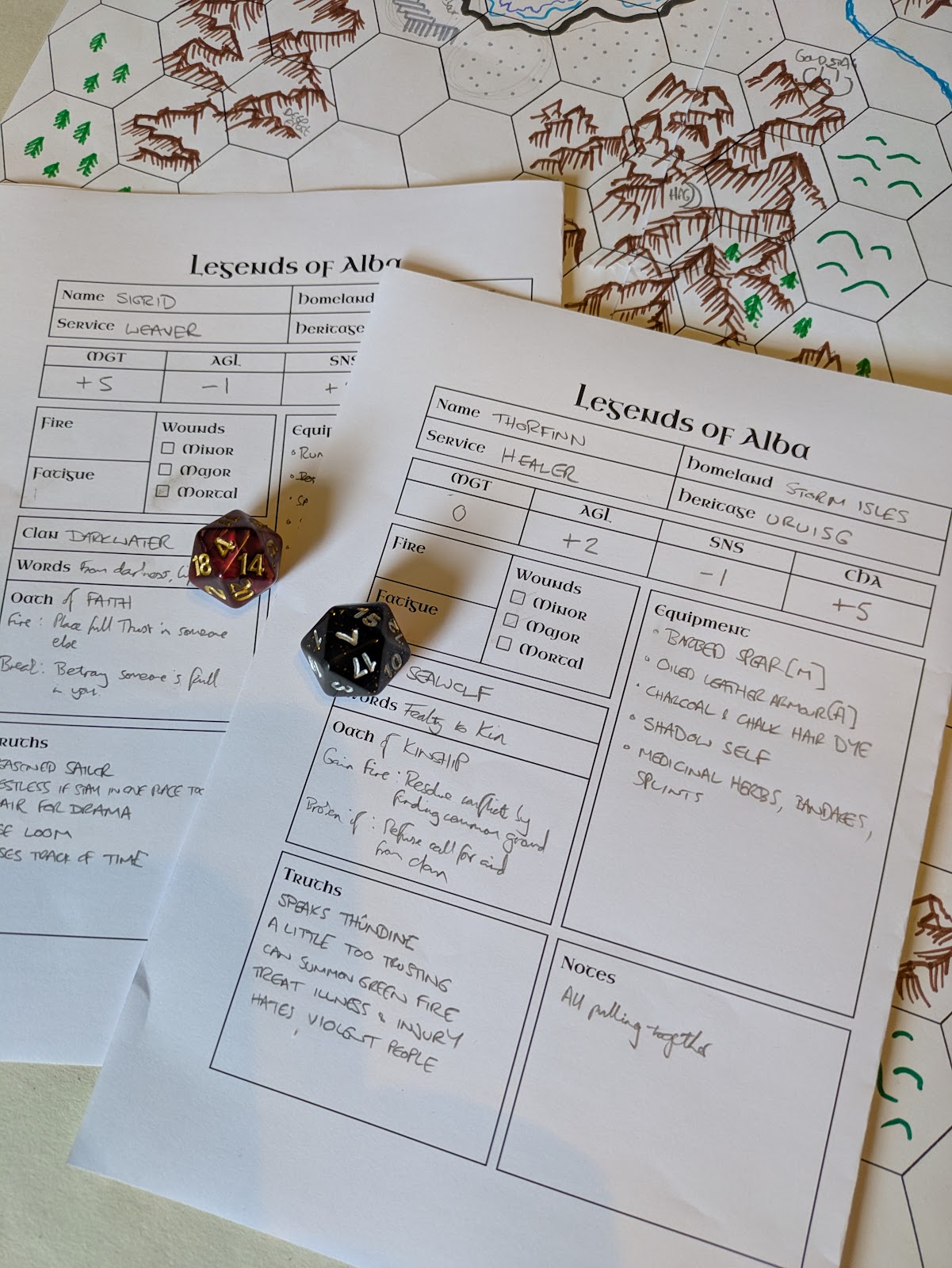
I thought I'd write up my notes from a very short Combat playtest. In this scenario we have 2 Characters, Thorfinn Seawolf and Sigrid Darkwater. They are travelling by land in the Storm Isles when they get attacked by 4 Muck Bogles! 

Muck Bogles are not too threatening a foe, so their Challenge is 10 (C10). I imagine they'd split their attacks between hurling dirt clods at Range, and good old fashioned fist-punching in Melee. Thorfinn and Sigrid ready themselves and leap into action!

Thorfinn & Sigrid vs The Muck Bogles

  • Round 1: Sigrid tightens her grip on her runic staff and strikes down one of the Bogles! Thorfinn doesn't fair so well, his barbed spear getting lodged in the Bogles mucky body, allowing it to strike back at him and deal a Minor Wound.
  • Round 2: Grumbling Thundine curses, Thorfinn frees his spear and takes out the Bogle that Wounded him. Sigrid's staff whistles through the air to take down a third.
  • Round 3: With a voice like thunder, Sigrid calls on the Might of Teran, God of Storms, to Help Thorfinn take down the final Bogle.
Victory for the Characters! They take a moment to let Thorfinn catch his breath, recovering from his Minor Wound before pressing on.

The following day they come across an alarming scene: The Crystal Wyrm attacking a crofting hamlet! Its huge form hangs in the air, pale and scaleless, embedded with glittering purple crystals. In its paranoia, it has come to believe these crofters have been conspiring against it. This is a desperate situation, The Crystal Wyrm is easily capable of delivering on this threat and worse, its Challenge is 25 (C25). Still, Thorfinn and Sigrid have heard the Covens' Call to answer The Legends - they have to do something. So here they go.

Thorfinn & Sigrid vs The Crystal Wyrm

  • Round 1: Thorfinn dives at the Wyrm's claw with his spear, only for it pull back and score a deep gash that opens his forearm - gah! A Major Wound! Sigrid gathers her strength and tries to shove the sharp end of her staff into the Wyrm's pale skin. This goes disastrously wrong, as the Wyrm blocks the attack with its crystalline tail, skewering Sigrid straight through the gut with one of its spines. A Mortal Wound: Sigrid is dying.
  • Round 2:  The situation has become dire - Thorfinn & Sigrid need to get out of there. They choose to Flee, leaving the crofters to their grim fate.
With Sigrid carrying a Mortal Wound she needs treatment or she will die. Thorfinn served the Seawolf Clan as a Healer but is in bad shape himself and this Wound is beyond his skill. They are currently two days' travel from Windvale, home of The Thunderhawk Clan. Its the nearest Settlement and so they make their way there in search of an expert healer. Thorfinn keeps Sigrid's Wound clean and dressed on the way, while she offers her homespun shawl to bind his arm. Together they make it to Windvale where they find care and rest.

Thoughts

Even though this was a very staged, hand-wavey test of the combat, it was immensely helpful. It was fast to resolve and still left plenty of room to paint a mental picture of the action based on the results of the dice rolls. I wanted to test both ends of the extreme in terms of Challenge and got pretty much the results I was expecting. The Characters easily bested the Bogles, whereas they were lucky to escape with their lives against The Wyrm. It also highlighted a few things to work on as well:
  • I had to add Rules on the fly for how to handle Mortal Wounds. The Character is dying, but what does that mean? Mechanically, I ruled that if you go to sleep with a Mortal Wound, you might not wake up. If anyone in the party is Mortally Wounded, healing should be their top priority.
  • It's my intention to add some random tables for Wounds so you can be specific. Thorfinn took a Major Wound to his forearm, which I just described for flavour. It might have been a Hindrance if he'd kept fighting though - whereas if he'd hurt his leg, that might have Hindered movement (arguably worse!)
  • I still need to add Rules for Fleeing combat. In my D&D games I've offered it as a party option which can be performed at the start of the Round if everyone agrees. The party get away, no Roll required, but suffer a narrative loss. I think it works just great!
That's it for now, till next time!

    RPG Character Psychology

    I've come across the work of the psychologist Carl Jung only really in passing, and most recently through Sharon Blackie's writing. ...