Saturday, March 15, 2025

Legends of The Storm Isles

This is quite an exciting post as it marks a big step towards being able to run games of Legends of Alba using the rules and tools I've been working on through this blog!

My aim is to have a ruleset that will allow players and a GM to run games set in The Storm Isles. This is Northernmost Kingdom of Alba, inspired predominantly by the geography and folklore of The Orkney Isles, but with an eye further North to Shetland and South to Caithness as well. If the rules work for The Storm Isles, I'll then look at fleshing out the other Kingdoms of Alba.

The Character Creation preview allows players to create characters from The Storm Isles. The Legends meanwhile are the GM's primary tool for bringing the game to life. Each Legend is centred around a folk tale or mythical creature, and contains a set of encounters (called Augurs) for the players to discover as they explore the Kingdom, which they must resolve in answer to The Covens' Call. I'll be sharing the procedure for this in another post but it's pretty much the same as for encountering Omens of the Myths from Mythic Bastionland.

You can read the first draft of The Legends of The Storm Isles here! Keep reading for some summary notes on the tales that inspired them.

A Shetland Fishing Boat in Stormy Weather North of the Orkney Islands,
Anton Melbye 1842, public domain from Picryl

The Fire Fish - inspired by The Marool from Shetland, this was a giant many eyed fish with flaming fins, feared for its hunting of ships during stormy weather. I thought it would be interesting for my take on it to have this sea-monster pitted against an angler, obsessed with landing it, and see what the players make of it.

The Grey Neighbours - The Trow are faerie-folk that feature prominently in Orcadian folklore. They're known for their love of music, and were attributed as sources of inspiration for musicians. I wanted this one to be a less adversarial Legend, but not without teeth. Could there be some unforeseen consequences to The Otherworldly inspiration of The Trow? The sleepless poet in this Legend might think so.

The Master Wyrm - Asipattle and The Stoor Wyrm is one of the most famous Orkney tales. Here I've put the Mester Stoor Wyrm as the first of the Ancient Great Wyrms (the Legends of Alba versions of dragons) and Asipattle is only hinted at as a dimly recalled ancestor of The Cindersift Clan.

The Mound Dweller - A take on the hog-boon by way of the film It Follows. The Mound Dwellers could be kindly spirits, but they were also guardians of the mounds they tended. Little kindness to be found here: Woe betide the witless thief that steals from a cairn protected by Haugbui!

The Seal Hunter - The actual story of The Seal Hunter ends quite amicably after a seal hunter unwittingly wounds the Queen of The Selkies. I wondered what it might look like if she wasn't quite so cool with it. There's also a gang of Orca in here (since Killer Whales are excellent seal hunters!) based on the story of the Law of The Tongue. That story is actually from Australia but it's too good not to include.

The Silver Tower - This started off as my take on the Finfolk. They were Storm Wizards who paddled around the seas in sealskin boats. I got an uncomfortable sense from the tales however that they originated from xenophobia towards the actual Fins and/or the Sami people. So stepping swiftly off that, I took the bare fiction as a jumping off point and now this is a weird Legend about metamorphosis. Enjoy!

The Storm Kelpies - For each of The Kingdoms I want to feature a big overarching Legend that will play out over the top of the others, a "Big Bad" as opposed to a "Monster of The Week". For The Storm Isles this had to be The Nuckelavee, the skinless cyclopean sea centaurs, truly nightmarish creatures! As the players encounter the damage wrought by these horrors from the depths, they'll also encounter a Dark Prince of the Sith on a bizarre quest of his own to try and control the abyssal beasts. The resolution of this Legend will reveal The One Who Dreams of Storms. The one who, it is said, will be able to control the dreaded Nuckelavee...

That's it for now, till next time!

Thursday, February 27, 2025

Monstrous Capitalism

I've had a setting brewing in the back of my mind for a while which is kind of Industrial Fantasy, maybe more about it another time, but I've been thinking about how some 'D&D' style monster types would fit into that sort of vibe. Ideas that came early on were for a Rakshasa who talks like Jeremy Irons and runs an Oil Refinery, a neurotic Beholder in charge of the Rail Network, a Dragon that owns a casino... what about an Treant? Or a coven of hags? I started writing up some stuff for some monstrous characters who would be big players in this world, oligarchs essentially, so here's a few of them:

Rail Master Shroder

Early in their career as Rail Master, Shroder's great fear was that the trains simply could not run on time without their oversight. Pursuing this neurosis to its natural conclusion, Shroder began to question whether an unobserved train could even exist, let alone reach it's destination on schedule.  This precipitated the appointment of the Rail Witnesses, now aboard every service. Under total superveillance, not only do the trains remain extant across appropriate realities, they run on time.

The Lendies

In ancient times, a Hag's value lay in her knowledge of The Truth. What place is there for such a creature in a world in which the only truth that matters is how much money you have? A hag might point out that money is not really a truth but more of a promise. She might add, however, that promises have pasts, presents and futures, themselves truths and thus known to her and her sisters. She might ask if there is value in knowing how money was acquired? In knowing where money might end up? She might then offer you a cup of tea while you peruse her consultation fees.

Mister Mulch

If a tree falls in the woods and there's nobody around, what is it worth? To whom is it worth whatever it is worth? If If a tree belongs to anyone, surely it belongs to the forest? Is it not reasonable, then, for the forest to be compensated if it's dead are repurposed for timber or firewood? Are not reparations due if tree murder is perpetrated purposefully, on an industrial scale? This was the general thrust of the argument put before the Big Log Firm by the Ambulant Pines of the ancient woods. Being the first discussion of any sort between these two parties, the thing most clearly brought to light was how poorly prepared for one another they were: The Lumberjacks and -Jills awed by the expressive limbs, creaking baritones and questing roots of the Ambulant Pines; the Pines themselves bedazzled by the champagne lifestyle of The Big Log Execs. Such meetings have a tendency to create an excitable and unstable energy, with the potential for outcomes as innovative as they are regrettable. It's exactly the sort of scenario that can result in a sentient tree, such as the Ambulant Pine who would later come to be known as Mister Mulch, getting the office with the big windows and the drinks cabinet and the fitted humidor, as Operations Director of the Big Log Firm.

That's it for this one, till next time!

Saturday, January 25, 2025

Tae The Legends!

It's Robert Burns day! About a year ago, I was putting together a players guide to start running some D&D games set in my Scotland-inspired setting, Legends of Alba. It wouldn't have been complete without a nod to the bard.

I wrote this poem as a sort of 'in-world' tribute to the titular Legends, the irregular phenomena that sweep through mythic Alba, waves of Otherworld chaos, changing both land and folk. I don't really write poetry so was looking for a framework to hang these ideas off of, and came across The Burns Stanza. I think this form gives it a bit of gravity, with some added "Scottishness" since it was so heavily used by Burns. I also can't vouch for the authenticity of the pseudo-Auld-Scots words, I followed my mind's ear. Besides, who knows how they spoke in this version of Alba?

Anyway, coming back to this wee poem a year later I still like it. I was going for a feeling of a wild land suffused with magic, and a hint of confrontations unseen but lurking and inevitable. The Legends have come before, have now come again, a force outside the player characters, so it's up to them how they make their mark in this time of upheaval. So it's supposed to be a bit of a call to action, and it actually puts more focus on the hubris of the clans than I remembered (which is good because that's turned out to be a big theme in the game as we've played!). Anyway here it is, with thanks and apologies to Rabbie Burns.

Tae The Legends

Auld Winter's bones begin tae thaw

An' maid-fire springs fae haggard claw

Come wolf, come deer, come hoodie craw

And listen well

Come them that ken the ancients' law

Tae seal the spell


From highland broch, the chiefs rule firm

Nae sleepin' giant nor cowerin' wyrm

Wuid tempt a dandy laird's concern

From guarded hill

They hae the mettle to return

And so they will


As river's run, cuts thro' the ben,

Fae cragged stack o'er peatland fen

'Neath merry dance a' nimble men

The augurs bide

Now see The Legends come again

Tae answer pride


Saturday, January 11, 2025

Creating an Otherworld Realm

One of my Legends of Alba groups has just started their second foray into one of the realms of The Otherworld. I’ve been refining my process for creating these realms since their first one, so I’ve recently had the opportunity to put the latest version to use. I quite like where it has ended up, so thought I’d share it here, and walk through the process to create a brand new realm in this very post!

Here is the Otherworld Creation process I’m following.  Let’s get started!

Step 1. Name and Describe the Realm

Results: Hope, Decay*, Whispering, River

OK this is quite interesting. I like having hope and decay both in there, those are quite contrasting ideas. Is this place the River of Whispering Hope? Maybe the Whispering River of Decay? I think I’m going to go with The Whispering River of Hope. Though it runs through a dying land, those souls who have lost hope might seek the river to hear a whisper of the truth, so their journey may continue.

* I originally rolled Roots for the nature element, but chose to re-roll this result because the realm I’ve just created for my players is called The Heath of Hateful Roots. I'd like to have something with a different natural element. It’s totally fine to re-roll or ignore results from these tables in pursuit of a spark of inspiration.

Step 2: Create Locations

Results: The Reaper’s Table, Mossy Stairs, Afflicted Tunnel, Infested Tower, Speaker’s Court, Pristine Barracks

The Reaper’s Table - how sinister! A place for a gathering or a feast? A rotten banquet laid out on this table would certainly emphasise the decay aspect! Perhaps the Reaper is willing to impart information to anyone who joins them in their disgusting feast.

The Mossy Stairs - I’d change the name to The Green Stair, but keep the fact that they are covered in moss. That suggests they are very old and seldom trod, so it’d be a challenge to climb them and claim the treasure that lies at the top.

Afflicted Tunnel - Probably a dangerous place, maybe the source of the affliction is a real problem in this realm?

Infested Tower - Another dangerous one I'd say! Is the owner of the tower still around? Maybe they are stuck inside, or they could even be the cause of the infestation.

Speaker’s Court - A source of power in the realm. What sort of proclamations does this Speaker make? Being known as a Speaker contrasts nicely with the river being said to whisper.

Pristine Barracks - This is a decaying land, so the presence of an order of warriors at a pristine barracks is interesting. Why are they pristine? Is it a mark of strict discipline? Are they magically so? Or perhaps they’ve never actually seen combat… I think these are good candidates for a wildcard faction, so whether they're enemies or allies would be up to the characters.

Step 3: Populate the Realm

Results:

  • Beast - jaded goose
  • Fuath - lizard, loch, laughter, strangling roots
  • Sith - merry princess, stardust, must marry a mortal

Jaded Goose - I normally think of geese as being noisy and aggressive, so the idea of a fed up, sulking goose plays against this expectation. A couple of things to think about though - like why are they so jaded? And is this one goose or a flock?

The Loch Lizard - Fuaths make great adversaries because they are driven by hatred, so they can be manipulated by the characters, or fought without inviting too much of a moral quandary. This giant reptile has scales like sodden bark, and claws that are gnarled and twisted like tree roots. It lives in a loch, perhaps a corrupted offshoot of the River that runs through this realm. If it hears so much of a hint of merriment it attacks the source, choking the life of it with its strangling root claws.

The Merry Princess - I’ll admit I had to have a little think about this one. ‘The merry princess’ gives a clear description of a character but sounds lame as a title. I googled the etymology of merry, which led me to the old English word ‘myrige’, which sounded like it could be a name. So this character is instead known as Princess Myrige, The Unburdened Heart. Her skin is as the night sky glittering with starlight, and she seeks a mortal spouse.

4) Create Magic Items

Results: Vagabond’s, barbed, bow, wisdom

Mashing these around I came up with: 

The Barbed Bow  - arrows fired from this bow sprout barbed vines to entangle their target; and

Vagabond’s Wisdom - bottle of strong, magic liquor, consume it to get drunk but you are guaranteed to find your way to a warm bed tonight.

I made another round of rolls to get a third item:

Results: Thief’s, whispering, flute, sight. 

That led me to:

The Flute of Whispering Insight - appears to make no sound, no matter how hard you blow. But play it somewhere you’ve never been before to have it whisper a truth about your surroundings that only you can hear.

5) Make Connections

This is the “Draw the rest of the f***ing owl” step of the process where everything magically fits together. I like to start by writing a heading for the realm. Then the locations beneath it. Then I can start placing inhabitants and magic items in the locations based on a combination of idea fragments, intuition and (if all else fails) randomness. So I get something like this:

The Whispering River of Hope

  • The Speaker’s Court
    • Jaded Goose - why not have a goose in charge?
  • The Pristine Barracks
  • The Tunnel of the Afflicted
    • Princess Myrige, The Unburdened Heart - maybe the afflicted are sort of a cult that worships her?
  • The Infested Tower
    • The Loch Lizard - this is a tower on an island in the middle of the loch
    • The Barbed Bow - the barbs sort of tie in with the Lizard's strangling roots
  • The Green Stair
    • The Flute of Whispering Insight - not sure what this is doing here but I'll think of something
  • The Reaper’s Table
    • Vagabond’s Wisdom - it's liquor, so goes with the feast

From here it gets a bit harder to walk through the process. I jump around between locations, characters, factions, zoom in and out to consider locales and the realm as a whole. The aim is to get to the point where the realm ‘emerges’. I should be able to picture it clearly when I think about it. Everywhere should at the very least have something interesting going on for the player characters to get involved with. You should feel free to make changes to your results, discard results or generate extra ones to help you reach something you can imagine more clearly.

Here's where it got to when I decided to call it done.

The Whispering River of Hope

A wide, deep river runs through a stinking bog. Folk cower in waterlogged shanties, half-sunken amongst rotten trees and spongy moss. The river itself is clear and pure, and said to whisper truths that inspire hope in those who need it most.

The Speaker’s Court

Once a power in this realm, the old goose has gone deaf. Many years have passed since she last heard the river. Much of her time is given to silent sulking, indifferent to the tawdry depths of scandal and intrigue into which her once-proud court has sunk.

  • Her Eloquence The Speaker, jaded giant goose, wants to be left alone.
  • Vapid goose courtiers, want to know what everyone else is up to.

The Immaculate Barracks

A fortress of white stone. Knights in white plate mail practise archery and swordplay. They await orders from The Speaker. They have been waiting for some time.

  • The Immaculate Knight-Captain Arnol, forgetful, wants the best for his Knights
  • Immaculate Knights, constantly fussing over their weapons and armour, want to be in a real fight
  • Erudite squires, not enough to do, convinced this will change when they finally become knights

The Tunnel of the Afflicted

The Afflicted are those blessed by Princess Myrige, whose beautiful laughter issues from the bowels of her dank tunnel city. Her subjects are immortal beyond the bounds of flesh, their rotting bodies host to myriad invertebrate life and mycelia.

  • Princess Myrige, The Unburdened Heart. Her skin is as the night sky glittering with starlight. Light hearted, laughs easily and often. Refused her coronation and never looked back, wants to bless as many as she can so others can share in her freedom.
  • The Afflicted. Content in their loyal service, tenacious in their search for a mortal spouse for their beloved Princess.

The Infested Tower

Long ago the island sanctum of a forgotten druid was swallowed by the loch that once protected it. Now it is the lair of The Loch Lizard, infested with its filth. The vile Fuath offers The Barbed Bow to whoever puts an end to the Princesses insufferable mirth.

  • The Loch Lizard, Strangleclaw. Scales of sodden bark, claws gnarled and twisted like tree roots. Hates the sound of laughter.
  • The Lizard’s Filth, reeking mud clumps, vaguely sentient, hungry for mortal flesh.
  • The Barbed Bow - arrows fired from this bow sprout barbed vines that entangle the target.

The Green Stair

These stone steps once led to the seat of coronation, where the Kings and Queens of the realm were crowned. Forgotten by most and engulfed by moss, the seat at its peak lies empty, a strange flute is all that remains of the crown jewels.

  • Engulfing moss - deadly hazard to anyone climbing the stair
  • The Flute of Whispering Insight - appears to make no sound, no matter how hard you blow. Play it somewhere you’ve never been before to have it whisper a truth about your surroundings that only you can hear.

The Reapers’ Table

A spoiled banquet moulders on a great rectangular table. There are some empty seats, the rest filled by Reapers. Stymied by the longevity of The Afflicted, they recoup what they can from the souls of the bog folk. They offer a bottle of Vagabond’s Wisdom if their gratitude is earned.

  • Reapers, tall crow-headed soul collectors. Having grown tired of one another, the only thing they love more than their rancid grub is sharing it with good company. 
  • Vagabond’s Wisdom - strong, magic liquor, consume to get drunk but you are guaranteed to find your way to a warm bed tonight.

Thursday, November 28, 2024

Map Locations

In this post I wrote about some strengths of Elden Ring’s map. Since then I’ve started a new Legends of Alba campaign (bringing us up to 3!), so I had a chance to revisit what goes into the hex map. This new game, like the others, is being run as a D&D 5E game. But the map doesn’t know that. So my hope is that this can inform the ref’s advice for creating a map for running their own games, as part of the Legends of Alba game rules.

For this post I’m just going to write about the types of locations that go on the map.

Legends

Pretty important in a game named Legends of Alba, these are the source of The Legends. When the players have a random encounter while travelling, the closest Legend Hex determines what this is. So if the players are closest to the Kelpie’s hex, they might encounter a rough river crossing with a white horse drinking there. The horse kneels, inviting them onto its back…


Settlements

1 Capital, a fortress city where the Kingdom monarch reigns. 2-3 Strongholds, hill forts of the Great Clans. And 2-3 Smallholdings, humbler homes to minor Clans. Settlements are places for the Characters to seek hospitality, local information and lore, and trade. They are also political hotbeds as there is always drama between and within the Clans - there’s plenty of opportunity here for the players to get involved to start making and breaking alliances to their advantage.

Monday, October 21, 2024

5E Selkie Species

I ran a 5E one-shot for some new players recently in the Legends of Alba setting. My partner was playing in the game and has been keen to play as a selkie character for a while, so it seemed like the perfect opportunity to put together some rules for a selkie species. I've tinkered with them a little since our game and wanted to share it here for anyone else who fancies playing as a Selkie in D&D 5E!

Selkie by James Browne

Selkie

Selkies are Fey shapeshifters, each possessing a seal skin that allows them to transform between seal and human form. They are the children of the Goddess Mitha, Mother of The Sea, whose song calms the most violent tempest. It is this song, the song of the summer tides, that imbues the spirits of Selkies with the light and magic of The Feywild. With a song in their soul, it is no surprise that so many Selkies exhibit an open joy in movement, moving through the steps of their long lives (commonly over 400 years) as though through the steps of a dance.


In their seal skin, their seal form grants them speed and grace in the water, as well as the ability to withstand and navigate the cold darkness of the deep sea, where submarine caverns hide the Fey Crossings to The Land Beneath The Waves. So a selkie’s seal skin is their greatest treasure: It is their connection not only to nature, to the wild seas and their Goddess, but to their ancestral Feywild home.


Though their hearts belong to the Sea, Selkies are often drawn towards the land. When a Selkie removes their seal skin, they are indistinguishable from humans. They can therefore be found in coastal communities throughout the multiverse, living among the short-lived folk till the ebb of the tide calls them home at last.


Selkie Traits


Creature Type: Fey Size: Medium (about 4-6 feet tall) Speed: 30 feet As a Selkie, you have these special traits. Darkvision. You have Darkvision with a range of 60 feet. Seal Form. You possess a seal skin. Once per round, you can don or remove your seal skin for free to shift between Seal and Human Form. The following traits apply to you in Seal Form: Speed: 10 feet, swim 40 feet Armor Class: 11 + Dexterity modifier (natural armor). Hold Breath: You can hold your breath for 10 minutes. Damage Resistance: Cold. Bite: Melee Weapon Attack (Strength), 5 feet, D6 piercing damage. In addition:
  • You lose the benefit of worn or carried equipment, which merges with you into your seal form.
  • You can’t cast spells, but shifting does not interfere with spells you’ve already cast.

Wild Nature
. Your deep connection to the Feywild grants you proficiency in one of the following skills of your choice: Athletics, Acrobatics, Insight, Nature, Performance, Survival.

Friday, October 11, 2024

Elden Ring Has a Good Map

I’m not normally a big fan of exploration in computer games. So why am I still having a blast exploring the open world of Elden Ring? A big part of it is down to the map and specifically how the map is populated.

Progression in Elden Ring is gated by challenging Legacy Dungeons. Each of these are unique and packed with visual storytelling, setting the tone for a memorable Boss battle at the end. This is the content that the game is pushing you towards, and for good reason: These sections should seem very familiar to anyone who’s played the Dark Souls games. FromSoftware has a proven track record of getting this stuff right.

But unlike Dark Souls, Elden Ring is open world. Often there is nothing whatsoever preventing you from galloping between Legacy Dungeons. You don’t need to explore the open world, so why bother?

Because the Legacy Dungeons are very difficult and, unless you’re a very skilled player, you’ll need all the help you can get. This is where the exploration element reveals itself as core to the Elden Ring experience. By exploring, your character will become more powerful, you’ll get better gear and that will help you in the Legacy Dungeons. As you explore, you’ll also start to recognise ‘types’ of location, each of which serves a purpose. All of this together elevates the exploration from being a grind or worse, a pointless activity, to being something that sparks imagination and curiosity.

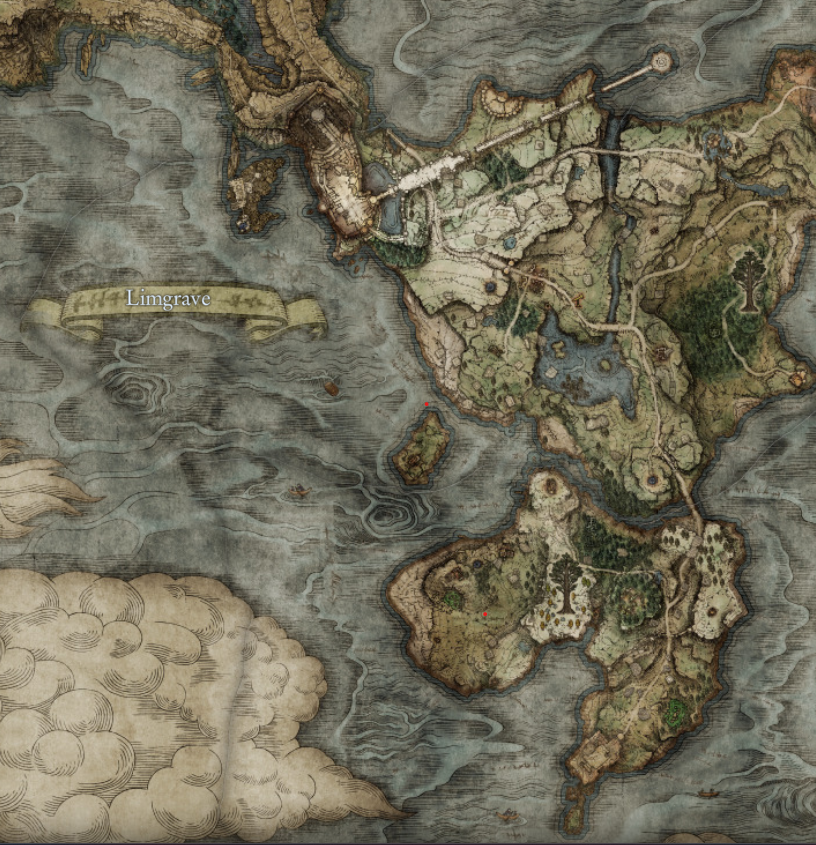
Limgrave

Let’s look at what sorts of locations you can find in Elden Ring:

Legacy Dungeons are usually huge castles in a prominent location. They’re large and challenging areas culminating in a significant Boss fight. These are your road-block Boss areas discussed above. Certain very powerful Bosses yield a Great Rune on defeat, a fragment of the titular Elden Ring whose power can be unlocked at Divine Towers.

Divine Towers are drawn as star-shaped towers on the map. They have strong connections to The Two Fingers - a major religious presence in the game. Each tower is linked to a Boss whose Great Rune can be unlocked at these locations to gain access to their unique weapons, armour or spells.

Minor Erdtrees show as large stylised trees on the map. They’re lesser versions of the Great Erdtree, that one gold tree that’s so big that you can usually see it if you can see the sky. Each Minor Erdtree is guarded by a stalwart Erdtree Avatar, a mini-boss made of roots. Defeating this guardian grants you a Crystal Tear: Items which you can combine in your Flask of Wondrous Physik to give your character a powerful buff.

Catacombs are not marked on the map but are normally found near Minor Erdtrees, signposted by a statue bearing the message “Guide and gatekeeper for those returning to the roots”. Following the direction indicated by these statues leads to a Catacomb - so maybe the statues are placed there to help lost souls find their way to the afterlife. The Catacombs themselves are tricksy mini-dungeons: Traps and ambushes abound. Usually you have to find a lever hidden within the dungeon to open the door to the boss. These areas are rich in Grave Gloveworts, an upgrade material for your Spirit Ashes (helpful allies you can summon during Boss fights)

Caves/Tunnels have their entrances marked as glowing pits on the map. Usually they present as mines, many of the enemies here are just working away and not hostile unless you go right up to them and start fighting them. These also usually have a mini-boss at the end. These are the best places to find Smithing Stones, the upgrade materials for your Weapons.

Wandering Mausoleums are bizarre huge tombs that walk around on four stone pillar-like legs. They are not marked on the map but you know when they are near when you hear their dolorous bell ringing. You can also hear them stomping around if you’re close enough. You can knock these over to duplicate Remembrances, providing some good utility in giving you a second chance with a powerful single-use item. They also serve the important role of reminding you that the world of Elden Ring is weird AF.

Evergaols are marked on the map by concentric circles. They are stone-floored circles which can be activated to transport your Character to a sort of pocket dimension where you fight a Boss who is imprisoned there. You’ll be rewarded with runes to help you level up, and a potentially useful item.

Ruins hint at a forgotten past and are usually populated by enemies. They often conceal a basement with a helpful item.

Churches enforce the presence of Marika, the missing ruler of The Lands Between. They are a good place to look for NPCs and grant the rare Sacred Tears, which help your character regain health.

Rises are wizard’s towers, though more often than not the owner is absent. They will usually present a puzzle such as “find 3 sacred beasts” (which in Elden Ring are, of course, turtles) to grant access. Your reward is a memory stone, which allows spellcasters to memorise more spells.

Forts are usually intact, well guarded strongholds. A direct approach will normally be met with a hail of fire or arrows from unseen assailants. So caution and knowledge of the layout is advised. You’ll normally face one or more difficult 'commander' type enemies, such as Knights, with a weapon or other useful item as your reward.

Villages tend to be places where something awful has happened. You are invariably much too late to save anyone but you can learn something about what happened (and when a place is named “Frenzied Flame Village” that can be a big motivator), meet NPCs and find items here.

Shacks are humble dwellings dotted around the world. Sometimes they are shelters for NPCs, they are also likely to contain spells or upgrade materials. These are fairly minor, sometimes almost incidental, locations but I think go a long way towards making the world like real people lived here.

That’s not even an exhaustive list of all the types, but hopefully more than enough to convey the strength of Elden Ring’s open world and why I love to explore it. Everywhere has a purpose, everywhere has a story. Exploration in Elden Ring is never a waste of time.

Anti-Canon

I don't plan to include a full 'History' section in Legends of Alba. Currently this is about as much as I want to include:  Befo...